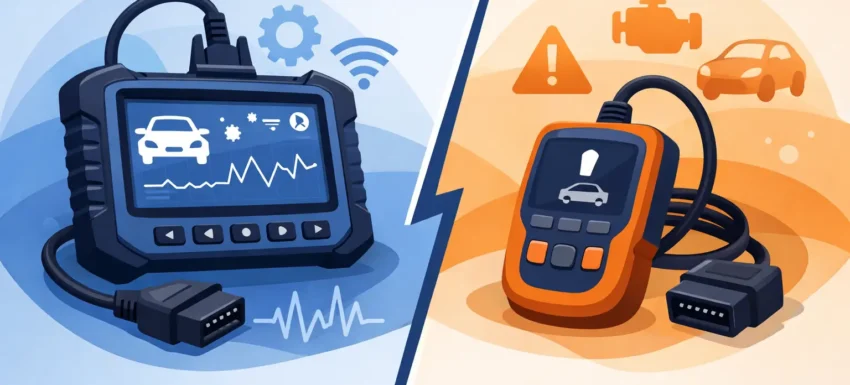
A warning light comes on, the customer wants an answer now, and guessing is the quickest way to waste time. That is where the OBD2 scanner vs code reader question matters. On paper they can look similar. In practice, they serve very different jobs, and choosing the wrong one usually means limited data, slower fault finding, or buying twice.
For some users, a basic code reader is enough to confirm why the engine management light is on and clear the fault once repairs are complete. For others, that same tool becomes a dead end within minutes because it cannot access live data, deeper modules, service functions, or manufacturer-specific information. The right choice depends on what you need the tool to do on the vehicle in front of you.
OBD2 scanner vs code reader: the basic difference
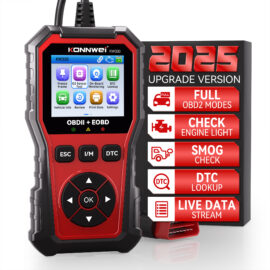
A code reader is the simpler of the two. Its main job is to read and erase diagnostic trouble codes, usually from the engine system, and in many cases it focuses on generic OBD2 emissions-related faults. If your aim is to identify a straightforward fault code and get a quick starting point, it does that job well.
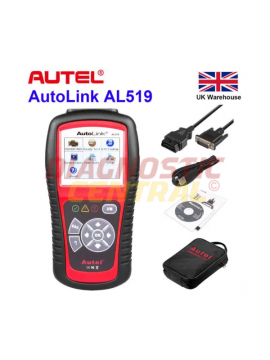
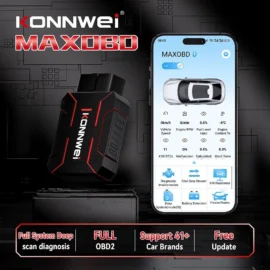
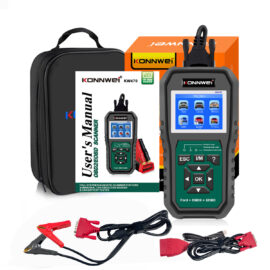
An OBD2 scanner goes further. It still reads and clears codes, but it also gives you broader access to vehicle data and functions. Depending on the model, that can include live sensor readings, freeze frame data, readiness status, battery and charging checks, service reset features, and access to additional control modules such as ABS, airbag, transmission, or body systems. In workshop terms, a scanner helps you diagnose. A code reader mainly helps you identify.
That distinction matters because a fault code on its own is rarely a finished answer. A code tells you where to start looking. The scanner gives you the supporting evidence.
What a code reader is good at
A code reader suits drivers, enthusiasts, and some workshops that want a quick first-pass check without paying for functions they will not use. If the vehicle has an engine warning light and you need to know whether the issue points towards a misfire, oxygen sensor fault, EVAP leak, or catalyst efficiency problem, a code reader can be a useful low-cost tool.
It is also a sensible option for basic maintenance checks. Plenty of competent DIY users keep one in the glovebox or garage because it can save a trip to the workshop for minor investigations. If the light returns after a repair, they can confirm whether it is the same code or a new one.
The limitation is simple. Once the problem becomes less obvious, the code reader often runs out of road. It may tell you there is a fault with a sensor circuit, but it will not always show whether the sensor reading is believable in real time, whether another system triggered the fault, or whether related modules have stored communication errors.
What an OBD2 scanner adds
A proper scanner is built for decisions, not just code retrieval. Live data is one of the biggest advantages. Being able to see coolant temperature, fuel trims, oxygen sensor activity, throttle position, MAF readings, battery voltage, or DPF-related values changes how quickly you can separate a genuine component failure from a wiring issue or an intermittent condition.
That is the difference between replacing parts and diagnosing faults properly. If a code points to a lean condition, for example, live data can help you see whether fuel trims support that diagnosis, whether the MAF is under-reporting, or whether a vacuum leak is more likely. Without that data, you are working with half the picture.
Many scanners also access systems beyond the engine ECU. That matters on modern vehicles where dashboard warnings may involve ABS, SRS, steering angle sensors, parking brake modules, or transmission control units. A basic code reader often cannot touch those systems. A scanner can.
For garages and mobile technicians, service functions are another major step up. Oil reset, EPB reset, battery registration, steering angle calibration, DPF regeneration, injector coding, and throttle relearn functions can turn a scanner from a diagnostic tool into an everyday workshop asset.
Why the cheaper tool is not always the cheaper option
Plenty of buyers focus on entry price first. That is fair enough, but diagnostic tools should be judged by what they save in time and misdiagnosis, not just what they cost on the day of purchase.
If a code reader tells you only that a fault exists, but you still need another machine, another booking, or extra labour time to investigate properly, the cheaper tool has not actually saved money. It has just delayed the real diagnosis. For a professional workshop, that delay costs more than the price gap between a basic reader and a capable scanner.
For a DIY user, the calculation is slightly different. If you only want to check occasional engine fault codes on your own car, paying for advanced bi-directional tests or full-system access may be excessive. That is where a code reader still earns its place. The key is buying with realistic expectations.
OBD2 scanner vs code reader for different users
If you are a car owner who wants to understand an engine warning light before booking repairs, a code reader may be all you need. It is simple, affordable, and usually quick to use. It gives enough information to avoid being completely in the dark.
If you maintain more than one vehicle, deal with intermittent faults, or like carrying out your own repairs, an entry-level scanner is usually the better buy. The extra access to live data alone can justify it.
If you run a garage, work as a mobile mechanic, or diagnose faults daily, the answer is straightforward. A code reader is too limited to be your main tool. You need a scanner with reliable vehicle coverage, stable software, and enough system access to handle the variety coming through the workshop. Anything less creates bottlenecks.
If you work on vans, lorries, or mixed fleets, compatibility becomes even more important. Not every scanner covers commercial vehicles, and not every code reader handles them properly either. In that case, buying on price without checking coverage is a mistake.
The features that matter most
The most useful diagnostic tool is not necessarily the one with the longest specification sheet. It is the one that matches your day-to-day work. Vehicle coverage comes first. A scanner loaded with functions is no use if it does not support the makes, models, and systems you actually see.
After that, pay attention to live data quality, update support, system coverage, and service functions. A fast interface and clear menus matter more than many buyers realise. In a workshop, poor navigation wastes time. On the driveway, confusing menus put off less experienced users.
Build quality also matters. A tool used in a trade environment needs to cope with regular handling, repeated plug-ins, and long sessions on awkward vehicles. Cheap hardware with weak connectors or unreliable communication tends to fail at the worst moment.
That is one reason buyers in the UK often prefer dealing with a specialist rather than a generic marketplace seller. Proper product knowledge, realistic compatibility advice, and access to replacement accessories make a real difference once the tool is in use.
When a code reader is enough and when it is not
A code reader is enough when the job is narrow. You want to read an engine-related fault code, clear it after a repair, or carry out simple checks on your own vehicle. It is also useful as a backup tool because it starts quickly and keeps things simple.
It is not enough when faults involve multiple systems, when the problem is intermittent, when the warning light is only part of the story, or when service procedures need electronic resets. It also falls short when manufacturer-specific data is required. Modern vehicles rarely make diagnosis easier, and simple tools cannot fill gaps they were never designed to cover.
That is the real answer to OBD2 scanner vs code reader. One is a basic access point. The other is a working diagnostic platform.
Choosing properly the first time
The best buying decision starts with honesty about how the tool will be used. If you want quick answers to simple engine faults, buy a code reader and keep it straightforward. If you want to diagnose efficiently, support repair work, and deal with modern vehicle electronics with confidence, buy a scanner with the right coverage and functions.
At Diagnostic Central, that distinction matters because buyers do not need vague promises. They need tools that match the job, whether that is a simple home check or daily workshop fault finding. The right diagnostic equipment should reduce guesswork, speed up repair decisions, and give you data you can trust.
When the next warning light appears, buy the tool that gets you past the code and closer to the cause.