A car that starts fine on Monday and clicks on Wednesday usually is not being dramatic – it is warning you that the battery, charging system, or both need checking. If you want to know how to test car battery condition properly, you need more than a quick glance at the terminals. A proper test tells you whether the battery is charged, whether it can deliver current under load, and whether the alternator is actually supporting it.
For garages, mobile technicians, and capable DIY owners, that matters because guessing wastes time. Replacing a battery that is only discharged will not fix a charging fault. Blaming the alternator when the battery has a dead cell sends you in the wrong direction just as quickly. Good battery testing is about separating state of charge from real battery health.
How to test car battery without guessing
The quickest way to get useful information is to test in stages. Start with a visual inspection, then check resting voltage, then observe cranking voltage, and finally confirm charging voltage with the engine running. If you have a dedicated battery tester, you can go further and assess cold cranking performance and internal resistance, which gives a much clearer picture than voltage alone.
Before testing, let the vehicle sit with the engine off for a while if possible. A battery checked immediately after driving may show a surface charge that makes it look healthier than it really is. If the lights have been on or the vehicle has recently failed to start, the reading may also reflect temporary discharge rather than long-term condition. Context matters.
Start with the basics
Open the bonnet and check for obvious issues first. Loose terminal clamps, heavy corrosion, swelling in the battery case, electrolyte leakage, or damaged cables can all affect results. A battery can test badly because current is struggling to get through poor connections rather than because the battery itself is finished.
If the terminals are dirty, clean them before relying on your readings. If the case is bulging or leaking, stop there and replace the battery. Physical damage is not something to test around.
Testing with a multimeter
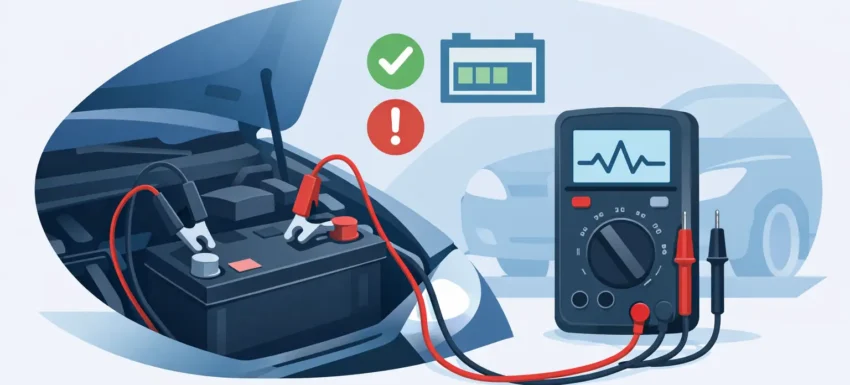
A digital multimeter is the most common starting point and often enough for initial diagnosis. Set it to DC voltage, connect the red probe to the positive terminal and the black probe to the negative terminal, and read the voltage with the engine off.
A healthy fully charged 12V battery will usually sit around 12.6V. Around 12.4V suggests partial charge. Around 12.2V is getting low, and anything near 12.0V or below means the battery is significantly discharged. That does not automatically mean it is faulty, but it does mean you cannot judge battery health properly until it is charged.
This is where many people get caught out. Voltage tells you state of charge, not the full story. A battery can show 12.6V and still collapse under load because its capacity has deteriorated. Equally, a good battery can show a low standing voltage simply because the vehicle has been left parked too long or there is a parasitic drain.
Check voltage while cranking
The next test is more revealing. Watch the multimeter while someone starts the engine. During cranking, battery voltage will drop. On most passenger cars, it should generally stay above about 9.6V in normal temperatures. If it drops well below that, the battery may be weak, undercharged, or there may be excessive starter current draw.
That last point matters. A low cranking voltage is not always the battery’s fault. A failing starter motor, poor earth, seized engine, or high-resistance cable can all skew the result. Battery testing is best treated as system testing.
Check charging voltage
Once the engine is running, test across the battery terminals again. Most vehicles should show roughly 13.8V to 14.7V, depending on system design, battery type, temperature, and smart charging strategy. If the reading stays near resting voltage, the alternator may not be charging. If it climbs too high, you may be dealing with an overcharging fault, which can damage the battery and vehicle electronics.
On newer vehicles, charging behaviour can vary more than many expect. Smart alternator systems may reduce charging voltage at certain times to improve efficiency. That means you need to interpret readings in context rather than forcing every vehicle into one narrow number range.
Using a dedicated battery tester
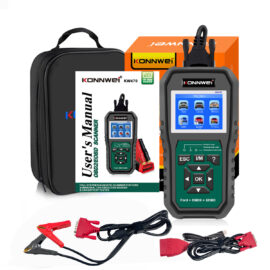
If you test batteries regularly, a dedicated tester is the better tool. It gives faster and more reliable results because it measures more than simple voltage. Depending on the model, it can test cold cranking amps, state of health, state of charge, internal resistance, and charging system performance.
This matters in workshop conditions where speed and accuracy are worth money. A proper tester can identify a battery that still holds voltage but no longer delivers sufficient starting power. It can also confirm whether a battery should be recharged and retested instead of replaced immediately.
For AGM, EFB, gel, and conventional lead-acid batteries, chemistry matters too. The correct test mode should match the battery type. Using the wrong setting can produce misleading results, especially on modern stop-start vehicles where battery specification is more critical than it used to be.
When a load test helps
Traditional load testing still has value, especially on older vehicles and standard lead-acid batteries. The tester applies a load and checks how well the battery maintains voltage under demand. If voltage drops sharply, the battery is struggling.
That said, modern conductance testers are often safer and quicker for routine use. They are less stressful on the battery and tend to suit busy garages better. For competent DIY users, they also make interpretation easier.
Common battery test results and what they mean
A battery at low voltage but with a decent health result often needs charging first, then retesting. That usually points to underuse, a drain, or a charging issue rather than immediate battery failure.
A battery with normal standing voltage but very poor cranking performance is often near the end of its life. This is a common pattern in ageing batteries that still appear fine until they are asked to start the engine on a cold morning.
A battery that repeatedly goes flat after charging may not be the main problem at all. The real fault could be an alternator not replenishing charge properly, or an electrical consumer staying awake when the vehicle is locked. Battery replacement without further checks is just parts darts.
If charging voltage is wrong, deal with that before condemning the new battery you just fitted. A fresh battery connected to a faulty charging system will not stay healthy for long.
How to test car battery on modern vehicles
Modern cars complicate battery testing because battery management systems, intelligent charging, and stop-start technology change how the vehicle behaves. You cannot always rely on one quick voltage reading and call it diagnosed.
On these vehicles, battery registration or coding may be required after replacement. If a new battery is installed without telling the vehicle’s control system, charging strategy may remain set for the old degraded unit. That can shorten battery life and create repeat issues. This is exactly why diagnostic capability matters alongside battery testing equipment.
Some vehicles also hide the battery in the boot, under seats, or behind trim panels, with remote jump points under the bonnet. Always test from the correct terminals and follow manufacturer procedure where relevant.
Safety and mistakes to avoid
Battery testing is straightforward, but careless handling causes problems. Do not short across terminals with tools. Wear eye protection if the battery is damaged or leaking. Make sure the meter leads are in the correct ports before testing voltage.
Avoid testing a deeply discharged battery and calling it failed without charging it first, unless it clearly has a dead cell or physical damage. Avoid relying on dashboard behaviour alone as well. Dim lights, warning messages, and slow cranking can point to a battery issue, but they do not confirm one.
Perhaps the biggest mistake is treating all no-start faults as battery faults. If the battery tests well, look at starter current draw, charging output, earth quality, and parasitic drain. The battery is often the victim, not the cause.
What tool should you use?
If you only need occasional checks, a decent digital multimeter will cover the basics and help you spot obvious faults. If you are testing vehicles regularly, a dedicated battery tester is the right investment because it removes guesswork and gives a clearer answer faster.
For workshops, mobile technicians, and serious enthusiasts, pairing battery testing with broader diagnostic equipment makes even more sense. Electrical faults rarely stay in one lane. Diagnostic Central focuses on that practical side of vehicle fault finding – tools that help you identify the actual problem rather than swapping parts and hoping.
A battery test should give you a decision, not just a number. If the battery is discharged, charge it and investigate why. If it fails under load, replace it with the correct type and specification. If charging voltage is wrong, move straight to the alternator and related circuits. That is how you test with confidence, save time, and stop comeback faults before they start.
The useful habit is not testing only when the car refuses to start. Test when cranking slows, when stop-start stops working, or before winter exposes a weak battery that was already on borrowed time.