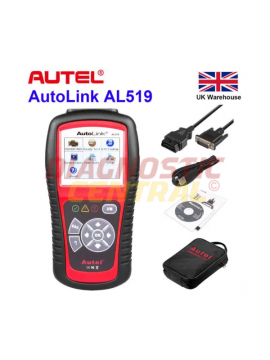
Spend enough time around modern vehicles and you learn this quickly: guessing costs money. A warning light, rough idle or emissions fault can point in five different directions, which is exactly why the best OBD scanner under £100 matters. At this price, you are not buying dealer-level diagnostics, but you can absolutely buy a tool that reads faults properly, gives live data and helps you stop changing parts on a hunch.
The key is knowing what under-£100 tools do well, where they fall short and which type suits the way you actually work. For a home user checking the family car, the right scanner can save repeated garage visits. For a mechanic, mobile technician or workshop that wants a quick code reader for first-line checks, a budget unit can still earn its keep if expectations are realistic.
What makes the best OBD scanner under £100?
Price alone is not the deciding factor. A cheap scanner is only good value if it reads the vehicle reliably, connects quickly and presents useful information without wasting time. The strongest options under £100 tend to get the basics right: engine fault codes, code clearing, live data streams, I/M readiness, freeze frame data and VIN reading on compatible vehicles.
That covers a lot of day-to-day diagnostic work. If the engine management light appears, you want to know whether you are dealing with a misfire, an oxygen sensor issue, an EVAP leak or something more serious before touching a spanner. If a car is heading for an MOT, readiness monitors matter. If an intermittent issue appears under load, live data becomes more useful than the fault code itself.
What tends to separate a decent budget scanner from a frustrating one is speed and clarity. Slow boot-up, poor menu structure and unstable connections become irritating very quickly, especially if you are using the tool more than once a month. Good budget units are straightforward, readable and dependable. They do not need gimmicks.
The main types of OBD scanner under £100
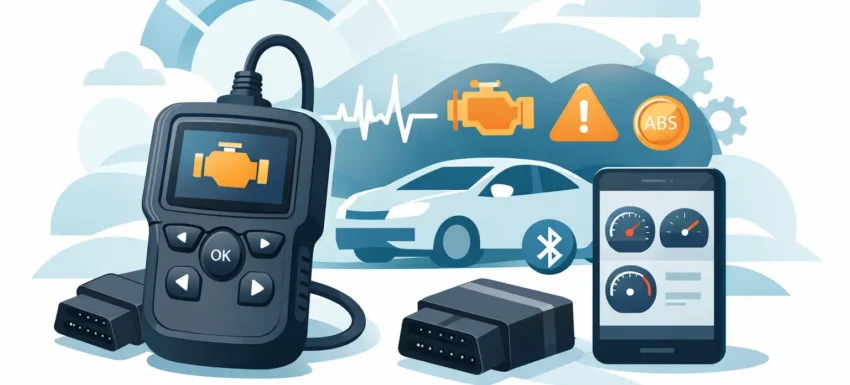
In this price bracket, most buyers end up choosing between a standalone handheld scanner and a Bluetooth or Wi-Fi dongle that works with an app. Both can be the best OBD scanner under £100 depending on the job.
Handheld scanners
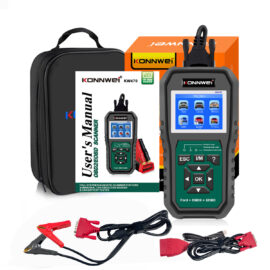
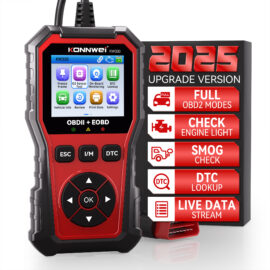
A handheld unit is the more workshop-friendly option for many users. It is self-contained, usually has a screen and buttons, and does not rely on your phone battery, signal or app compatibility. If you want a grab-and-go tool to plug into different vehicles quickly, handheld makes sense.
They are often the safer choice for garages and mobile technicians because there is less faff. You turn it on, plug in and read data. For older vehicles and straightforward engine diagnostics, that simplicity is a real advantage.
The trade-off is that cheaper handhelds can have basic screens and limited software depth. Many will not access advanced manufacturer-specific systems such as ABS, airbag, service reset or electronic parking brake functions. Some claim wide coverage, but in practice only deliver strong engine and emissions data.
App-based dongles
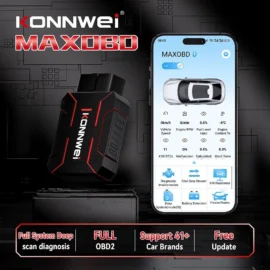
A phone-connected scanner can offer very good value. Because the processing and display happen through an app, you often get cleaner graphs, easier data logging and a more modern user experience. For technically minded owners, this setup can be excellent for monitoring live data over time.
The downside is compatibility and consistency. Some apps are better than others. Some dongles are stable on one phone and temperamental on another. If you need a tool that works every time without pairing issues, a cheap app-based unit can become more trouble than it is worth.
For enthusiasts and competent DIY users, though, a quality dongle paired with the right software can punch above its price. You just need to check exactly what the app includes before assuming it covers more than generic OBD2 functions.
Features worth paying for and features you can ignore
The most useful features under £100 are not glamorous. Live data, stored and pending codes, freeze frame, readiness monitors and a reliable DTC library do more for real fault finding than flashy packaging ever will. Graphing live data is especially helpful when diagnosing sensor behaviour, fuelling issues or intermittent running faults.
A code definition library built into the scanner also saves time, particularly for less experienced users. Reading P0171 is one thing. Understanding it points to a system too lean condition is another. That said, built-in definitions should be treated as a starting point, not the final diagnosis.
Some buyers get distracted by broad claims around full-system diagnostics. At under £100, treat that carefully. A scanner may communicate with more than just the engine on some vehicles, but support is often patchy across makes and models. If you specifically need ABS, SRS, transmission or service functions, check those claims with care. Generic OBD2 and true manufacturer-level diagnostics are not the same thing.
Screen size, cable length and build quality also matter more than people think. In a workshop or on a driveway, a unit with a short lead or flimsy casing soon becomes irritating. Practical details are often what make a tool usable every day.
Who should buy a budget scanner and who should not
If your goal is basic fault finding, warning light checks, emissions readiness and live engine data, an under-£100 scanner is often enough. This applies to many private motorists, used car buyers, enthusiasts and even busy workshops that want a fast triage tool before moving to more advanced kit.
If you are diagnosing complex electrical faults, coding modules, carrying out service functions across multiple marques or working heavily on newer vehicles with advanced systems, a budget scanner will not go far enough. It may still be useful as a first step, but it should not be your only diagnostic tool.
This is where buying on price alone becomes expensive. A £60 scanner that only half-connects or gives vague results is poor value. A £95 scanner with stable communication and accurate live data is far more useful. In diagnostics, dependable information beats a long feature list every time.
How to choose the best OBD scanner under 100 for your vehicle
Start with the vehicle, not the scanner. Most petrol cars sold in the UK from 2001 onwards and diesel cars from 2004 onwards support OBD2 or EOBD standards, but support for additional systems varies widely by make and model. If you mainly work on one vehicle brand, check whether the scanner has stronger compatibility there.
Then think about how you use it. If you want something to keep in the glovebox or toolbox for quick checks, a handheld scanner is usually the safer bet. If you like examining sensor graphs, logging runs and using your phone as a display, an app-based option could suit you better.
Also be honest about your own skill level. Some tools are better for reading and clearing codes than explaining what those codes mean in context. A novice usually benefits from a scanner with a clearer interface and better on-screen definitions. A technician may care more about refresh rate, data PIDs and communication speed.
At Diagnostic Central, this is exactly where specialist product choice matters. A proper diagnostics supplier will focus on compatibility, usable functions and real workshop value rather than marketplace-style feature inflation.
Common mistakes when buying under £100
The biggest mistake is assuming every scanner that plugs into the OBD port does the same job. It does not. Some are little more than code readers. Some offer strong live data. Some claim advanced functions they cannot deliver consistently.
Another common mistake is confusing fault code reading with fault diagnosis. A scanner points you in the right direction. It does not tell you automatically whether the sensor has failed, wiring is damaged, there is an air leak or a mechanical problem is causing a misleading code. Good diagnostics still require interpretation.
It is also easy to overbuy or underbuy. If you only want to check a warning light on your own car twice a year, you do not need workshop-level complexity. If you are a mobile mechanic trying to cover multiple makes every week, the cheapest option on the page will likely slow you down.
So what is the right buy?
The best choice under £100 is usually the scanner that is honest about what it can do. Look for solid generic OBD2 coverage, fast code reading, dependable live data and a build quality that will survive regular use. If extra system access is offered, treat it as a bonus unless compatibility is clearly proven for your vehicle range.
For DIY motorists, that often means a simple, reliable handheld unit or a reputable dongle with a strong app. For trade users, it usually means a no-nonsense handheld scanner that works quickly as a first-pass diagnostic tool before deeper testing.
A good budget scanner will not replace high-end diagnostic equipment, and it does not need to. Its value is in reducing guesswork, speeding up checks and giving you a clearer starting point before any parts are ordered or labour is booked. Buy for accuracy first, then features. That is what keeps a budget tool useful long after the novelty wears off.