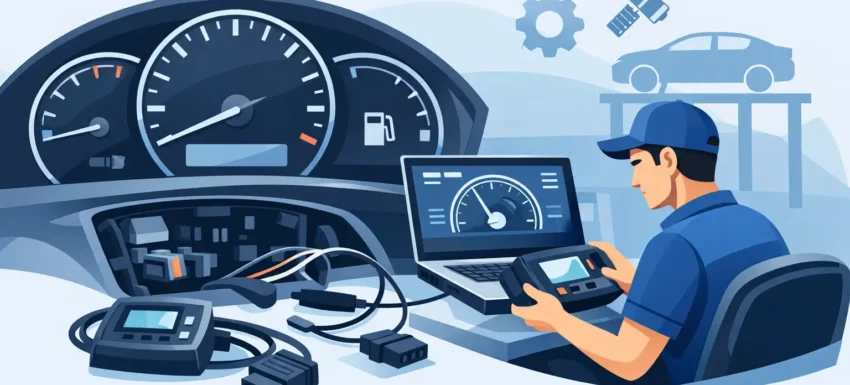
A vehicle comes in with a failed instrument cluster, a used replacement dash, or an ECU swap after electrical damage. The job is not finished when the part powers up. If the recorded distance no longer matches the vehicle’s stored data, the customer is left with an obvious problem. That is where mileage correction equipment enters the picture. Used properly, it allows technicians to read, adjust and synchronise mileage data in supported modules after legitimate repair work.
This is a specialist area of vehicle electronics, and it deserves to be treated that way. Buyers who expect a universal plug-and-play tool for every make, model and year usually end up wasting time and money. The right equipment is defined by coverage, memory support, connection method and the level of bench work you are prepared to take on.
What mileage correction equipment actually does
At workshop level, mileage correction equipment is designed to access odometer data stored in a vehicle’s electronic systems. Depending on the platform, that data may sit in the instrument cluster, body control module, ECU, EEPROM, MCU or more than one location at once. A capable tool can read existing values, identify the memory type and write corrected data where the vehicle architecture allows it.
That sounds straightforward on paper, but the real job varies enormously. Older vehicles may store mileage in one area and respond well to direct EEPROM access. Newer vehicles often spread the data across several modules and include checks designed to prevent mismatched readings. In those cases, success depends less on the headline product name and more on whether the tool supports that exact system properly.
For a garage, the practical use is clear. If you replace a faulty cluster with a used unit showing the wrong mileage, the recorded distance needs to be brought back into line with the vehicle’s actual stored value and service history. The same applies in certain module replacement scenarios where mileage data becomes inconsistent after repair. Good equipment reduces guesswork and gives the technician a controlled route to complete the job correctly.
Why garages buy mileage correction equipment
Speed is part of it, but accuracy matters more. Without the correct tool, technicians can lose hours removing clusters, tracing memory chips or testing software methods that simply do not suit the vehicle in front of them. A proper unit shortens the process by giving clear access to supported systems and by reducing the chance of corrupting data during the write stage.
The other reason is workshop credibility. Modern customers expect electronic repairs to be completed properly, not patched together. If a dash replacement leaves the odometer displaying the wrong figure, the vehicle immediately looks unfinished. For independent garages and mobile technicians, that sort of detail affects trust.
There is also a commercial case. Instrument repairs, used module installations and electronic refurbishment jobs are more viable when the workshop has the right hardware in-house. Instead of turning work away or sending it elsewhere, the garage can handle more of the process itself.
Mileage correction equipment is not one-size-fits-all
This is where many buyers get caught out. Some tools are aimed at quick OBD-based correction on selected vehicles. Others are bench-focused systems built around EEPROM and MCU programming. Some packages cover broad European applications; others are stronger on specific brands or older platforms.
A low-cost unit can be perfectly useful if it covers the exact vehicles you see every week. Equally, an expensive setup can still be the wrong choice if most of its capability sits outside your normal job profile. Before buying, it makes sense to look at the actual work coming through the door. A garage dealing mainly with VAG dashboards, for example, has different needs from a workshop handling mixed fleets, lorries or older French vehicles.
Vehicle age matters as well. Many older systems are more direct to work with, while newer encrypted platforms often demand stronger hardware, better software support and more advanced soldering or adapter use. If your technicians are comfortable with chip-level work, your options open up. If not, a tool with simpler guided functions may be the better investment.
What to look for in mileage correction equipment
Coverage should come first. Not broad claims, but specific supported makes, models, years and module types. Good equipment will tell you how the job is performed, whether by OBD, direct connection, adapter, clip or chip read. That matters because it affects labour time and risk.
Memory support is another major point. EEPROM and MCU compatibility makes a real difference in practical workshop use, especially when dealing with replaced or repaired clusters. If the tool only handles limited OBD procedures, it may fall short as soon as a job requires bench access.
Software quality is just as important as hardware. Clear menus, stable communication and sensible vehicle identification save time. So does proper file handling. Reading and backing up original data before any write operation is basic good practice, and the equipment should make that process straightforward.
Build quality should not be overlooked. Workshop tools are used repeatedly, sometimes under pressure and not always in ideal conditions. Cheap leads, poor clips and unstable interfaces create faults of their own. In this category, reliability is worth paying for.
Then there is support. Specialist tools need specialist backup. If a product arrives with vague instructions and no credible aftersales help, it becomes far less attractive, especially for garages taking on time-sensitive jobs. This is one reason many professionals prefer buying from dedicated automotive diagnostic suppliers rather than anonymous marketplace listings.
OBD correction vs bench programming
For many buyers, the biggest practical question is whether to prioritise OBD access or bench capability. The answer depends on your workload.
OBD-based mileage correction equipment is faster when it works. You connect through the diagnostic port, follow the software process and complete the adjustment with minimal disassembly. That suits busy workshops, mobile technicians and routine jobs on supported vehicles. The limitation is coverage. If the vehicle blocks OBD writing, stores mileage elsewhere or requires sync across multiple modules, the quick route ends there.
Bench programming is slower but far more versatile. Removing the cluster or module, identifying the memory and reading it directly gives greater control. It also demands more technical confidence. There is more handling involved, more chance of damage if the operator is careless, and a bigger need for clean data management. For electronic repair specialists, that trade-off is often worth it. For a general garage, it depends on how often those jobs appear.
In reality, the most useful setup is often a combination. OBD for efficient supported work, bench tools for the awkward cases that would otherwise stop the job.
Common buying mistakes
The first mistake is buying on headline promises alone. If a tool claims huge vehicle coverage but does not clearly explain module support or connection method, treat that as a warning sign.
The second is underestimating the learning curve. Even user-friendly mileage correction equipment still sits in a technical category. Staff need to understand file backup, module identification and the risks of poor write procedures. A tool does not replace method.
The third is ignoring update relevance. Software updates are useful, but only if they improve the vehicles you actually work on. Paying more for constant additions has limited value if your workshop mainly sees a stable range of older applications.
The fourth is treating price as the only benchmark. A cheaper tool that fails halfway through a cluster job is not cheaper once labour time and customer confidence are factored in.
Who should invest in mileage correction equipment?
For instrument repairers, auto electricians and garages already doing module replacement work, the case is strong. The equipment pays for itself by bringing specialist jobs in-house and improving turnaround.
For general repair workshops, it depends on frequency. If cluster changes, used part installations and electronic repair jobs are occasional, a focused entry-level setup may be enough. If your workshop is seeing more body control, dash and immobiliser-related work, stepping up to a more capable system makes commercial sense.
For competent enthusiasts, caution is sensible. Some tools are accessible, but this is not a category where guessing goes well. The more modern the vehicle, the less forgiving the job tends to be.
Diagnostic Central supplies workshop-focused electronic tools for technicians who need equipment that earns its place on the bench. In a category like this, that matters.
Choosing the right mileage correction equipment for your workshop
Start with the vehicles you see most. Then look at whether those jobs are handled by OBD, bench access or both. After that, check memory support, software quality and the level of technical skill in your workshop. Those points will tell you more than any flashy product claim.
The best purchase is rarely the biggest package on the market. It is the tool that matches your real workload, performs consistently and gives you a dependable route from faulty module replacement to finished repair. Get that choice right, and mileage work becomes less of a headache and more of a proper service line.