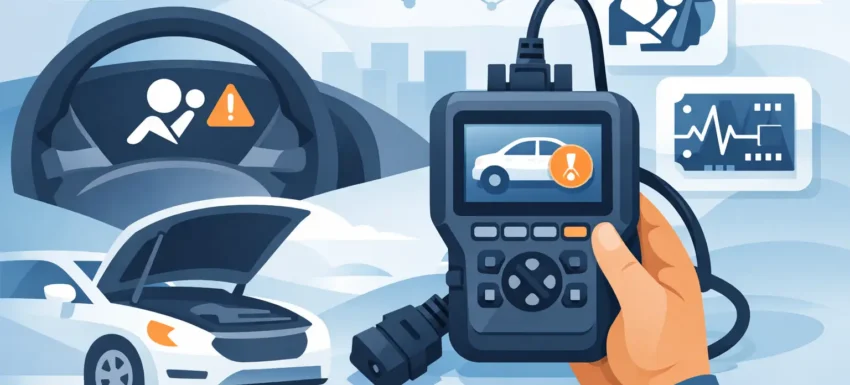
That airbag light changes the job straight away. What looked like a routine service or MOT preparation becomes a safety-system fault that needs proper diagnosis, not guesswork. A capable SRS airbag diagnostic tool gives you a direct route into one of the vehicle’s most sensitive control systems, helping you identify stored faults, check crash data status, and decide whether the issue is wiring, a module, a seat occupancy sensor, a clock spring, or a component that has genuinely failed.
For garages and technicians, speed matters, but accuracy matters more. The wrong approach to SRS faults wastes workshop time and can lead to unnecessary parts replacement. For experienced DIY users, the same rule applies. Reading an airbag warning light with a general code reader is often not enough, because many budget scan tools either cannot access the SRS module at all or only provide very limited fault information.
What an SRS airbag diagnostic tool actually does
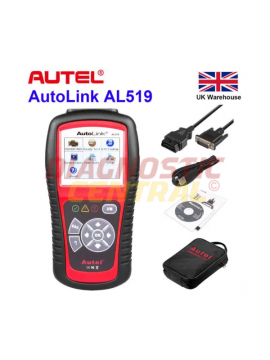
An SRS airbag diagnostic tool communicates with the vehicle’s supplementary restraint system control unit. That includes the airbag module itself and, depending on the vehicle, related systems such as seat belt pretensioners, occupancy sensors, side impact sensors and steering wheel squib circuits. Its job is to retrieve fault codes, display fault descriptions, and in many cases clear codes once the underlying problem has been repaired.
That sounds straightforward, but there is a big difference between basic access and useful diagnostic coverage. A simple tool may only pull a code and erase it. A better unit gives live data, module information, system status and stronger make coverage. In practice, that means less time spent chasing intermittent faults and less risk of fitting parts on assumption.
If you work on mixed makes, compatibility is the first checkpoint. SRS systems vary significantly across manufacturers, model years and communication protocols. A tool that performs well on one Vauxhall or Ford may offer weak airbag access on a Peugeot, BMW or newer hybrid platform. That is why workshop buyers tend to prioritise proven vehicle coverage over headline claims on the box.
Why generic scanners often fall short
A lot of low-cost scan tools are sold as all-in-one solutions, but their airbag functions can be shallow. They may read engine codes well enough, yet offer patchy access to body and safety modules. When the SRS lamp is on, that limitation becomes obvious quickly.
The problem is not just access. It is fault detail. Airbag systems are designed around strict monitoring logic. Resistance values in igniter circuits, seat sensor plausibility, voltage irregularities and communication errors can all trigger a warning. If your scanner only shows a vague code title, you still have half the job left to do with a multimeter, wiring diagram and process of elimination.
For a working garage, that delay costs money. For a mobile technician, it can mean a second visit. For a competent vehicle owner, it usually means frustration and uncertainty. A proper SRS-capable tool reduces all three.
How to choose the right SRS airbag diagnostic tool
The right tool depends on the vehicles you see and how deep you need to go. If your work is mostly service-based and you only need to confirm and clear common faults after repair, a mid-range unit with strong SRS coverage may be enough. If you are dealing with regular electrical fault-finding, salvage inspections or multi-brand diagnostics every day, you need broader system access and more reliable software support.
Start with vehicle coverage. Look at make, model and year compatibility rather than assuming universal support. Older vehicles may use manufacturer-specific communication, while newer ones may require better software depth to access full module data.
Then look at function depth. Fault code reading and clearing are the baseline, not the benchmark. Live data, ECU information, status monitoring and service-level reset capability can make the difference between confirming a repair in ten minutes and spending an hour second-guessing the result.
Build quality matters too. A workshop diagnostic tool needs to cope with daily use, repeated connections and constant handling. Cheap interfaces and weak cables are false economy. If the tool is intended for regular professional work, reliability is as important as feature count.
Software support should not be overlooked. Vehicle electronics change constantly. Without updates, even a good scanner starts to lose value. This matters most for independent garages working across newer vehicles, where keeping coverage current is part of staying efficient.
Key features that make a real difference in the workshop
The strongest tools combine clear fault identification with practical usability. Fast boot-up, sensible menu layout and stable communication save time on every job. That may sound basic, but in a busy garage those small gains add up quickly.
Live data is especially useful for SRS-related diagnosis where the fault is not a straightforward hard failure. You may need to observe seat occupancy status, pretensioner circuit recognition or voltage behaviour during inspection. A tool that only reads static fault memory gives you a starting point. A tool with live feedback helps you finish the job properly.
Code definitions also matter. Some scanners display only the raw code number, while others provide a proper fault description. Clear definitions improve repair decisions and reduce reliance on external lookups.
Another practical feature is the ability to identify module details accurately. Knowing the part number, software version or coding status can help when replacing or assessing an airbag ECU. That is particularly relevant after accident repair, flood damage or when dealing with used replacement modules.
Common SRS faults a diagnostic tool can help pinpoint
Airbag faults are often blamed on the module first, but the module is not always the culprit. In many cases, the issue sits in the surrounding circuit. Seat wiring is a frequent example, especially in vehicles where connectors under the seats are exposed to movement, moisture or poor previous repair work.
Clock spring faults are another regular cause, usually appearing alongside steering wheel control or horn issues. Pretensioner circuit problems, passenger seat occupancy faults and low-voltage events also appear often. On some vehicles, battery replacement or poor charging system performance can trigger restraint-system codes that stay stored until they are cleared after the electrical issue is corrected.
A good diagnostic tool helps narrow the fault path before anything is dismantled. That is the real value. It does not replace proper testing, but it tells you where to focus.
Safety and limitations
No diagnostic article on SRS systems should pretend these are ordinary circuits. They are not. Airbag and pretensioner systems are safety-critical and can be dangerous if handled incorrectly. A scanner helps with diagnosis, but it does not make poor workshop practice safe.
If the fault points towards a live restraint component, wiring repair or module replacement, correct procedures matter. Battery isolation times, connector handling and manufacturer instructions are part of the job. Clearing a code without addressing the cause is not a repair. It only hides the warning until the system runs its checks again.
There is also a difference between reading a fault and solving it. Some tools promise a lot in sales copy but offer limited real-world support once you reach less common vehicle platforms. That is why specialist suppliers matter. Buyers need realistic compatibility information, dependable hardware and advice based on actual use rather than recycled marketplace claims.
Who needs an SRS-specific tool?
Not every buyer needs a dedicated SRS-only unit. If you already run a full-system scanner with proven airbag coverage, a separate tool may add little. But if your current scanner struggles with body systems, or you need a cost-effective secondary device for airbag work, an SRS-focused tool can be a sensible addition.
Independent garages benefit because they see varied faults across mixed fleets. Mobile technicians benefit because a compact, dependable tool saves return visits. Experienced DIY users benefit because it gives them proper visibility into a warning light that a basic code reader cannot explain.
The best buying decision usually comes down to frequency of use. Occasional checks call for reliable basics. Daily workshop diagnosis calls for broader coverage, stronger software and hardware that will stand up to repeated use.
Diagnostic Central works in a specialist part of the market where those differences matter. The right tool is not the cheapest one that claims airbag access. It is the one that communicates properly, gives useful fault information and helps you move from warning light to verified repair without wasting time.
When an SRS lamp is on, guessing is expensive and clearing codes blindly is worse. Choose a tool that gives you proper system access, dependable coverage and enough depth to support the repair, not just identify the problem.