A battery that shows 12.6V can still fail to crank an engine on a cold morning. That is where the battery tester vs multimeter question stops being academic and starts costing time. If you work on vehicles regularly, or simply want to stop guessing at battery condition, you need to know what each tool actually tells you and what it does not.
For automotive work, these tools are not interchangeable in every situation. A multimeter is a general electrical test instrument. A battery tester is a purpose-built diagnostic tool designed to assess battery condition under real-world demand. Both have a place in a workshop, but they answer different questions.
Battery tester vs multimeter – the real difference
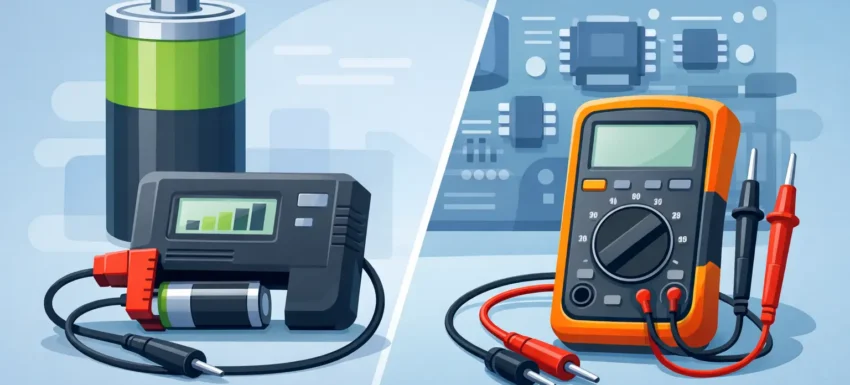
The simplest way to separate them is this: a multimeter measures electrical values such as voltage, resistance and current, while a battery tester evaluates battery health and starting performance. That distinction matters.
If you put a multimeter across a 12V battery, you will get a voltage reading. Useful, yes, but limited. Voltage alone does not confirm whether the battery can deliver enough current to start the vehicle. Many weak batteries look acceptable at rest, especially if they have just come off charge.
A battery tester goes further. Depending on the model, it can measure state of charge, estimate cold cranking capability, assess internal resistance and in many cases test the charging system and starter as well. For a garage trying to move from symptom to answer quickly, that extra information is what makes the tool valuable.
What a multimeter does well
A decent multimeter belongs in every workshop and every serious DIY kit. It is one of the most versatile tools you can own. On vehicles, it is used to check battery voltage, alternator output, continuity in wiring, fuse condition, parasitic drain and sensor circuits.
That versatility is its strength. If you are chasing an electrical fault beyond the battery itself, a multimeter is usually the first tool on the bench. You can confirm whether the battery is sitting at 12.6V, whether the alternator is charging at around 14V with the engine running, or whether a poor earth is causing a voltage drop.
It is also useful for basic battery checks. A fully charged lead-acid battery at rest will typically read around 12.6V to 12.8V. A lower reading may point to discharge. If the voltage collapses during cranking, that also tells you something. But it still does not give a full picture of battery health.
Where a multimeter falls short
The problem is not accuracy. The problem is scope. A multimeter can tell you the present voltage, but not necessarily the battery’s ability to perform under load. A sulphated or ageing battery can show a respectable standing voltage and still be incapable of delivering proper cranking current.
This is where many quick checks go wrong. Someone sees 12.4V or 12.5V, assumes the battery is fine, and moves on. The car comes back with a non-start, slow crank or intermittent voltage-related faults. In modern vehicles packed with control modules, that kind of half-diagnosis wastes time.
What a battery tester does well
A battery tester is built specifically for this job. It does not just report voltage. It helps determine whether the battery is serviceable, weak, discharged or due for replacement.
Most modern automotive battery testers work by analysing conductance or internal resistance rather than applying a large old-style load. That means fast testing, simple operation and less stress on the battery. Many units can test standard flooded batteries, AGM, EFB and gel types, which matters on newer start-stop vehicles and mixed fleets.
In practical workshop use, the advantage is speed. Clamp on, select battery type and rating, and you get a result that is far more useful than a raw voltage number. Good testers can also report available CCA, battery health percentage, state of charge, starter performance and charging system condition. That gives you a clearer path to the next job step.
Why that matters on modern vehicles
Modern vehicles are far less tolerant of low voltage than older cars. Weak battery performance can trigger stop-start faults, communication issues, warning lights, steering assistance problems and false fault codes. On some vehicles, a battery that is only marginal can create a long list of symptoms that look like module or sensor failures.
A proper battery tester helps separate a battery issue from a wiring, starter or alternator fault. That is not just useful. It protects against misdiagnosis.
When to use a multimeter instead
There are plenty of cases where a multimeter is still the right tool. If the battery tester says the battery is good but the vehicle still has a charging or starting complaint, you will need to go deeper. A multimeter lets you verify voltage drop on the positive and earth sides, check alternator output under load, inspect fuse feeds and trace circuit losses.
It is also the more suitable tool when the issue is not really the battery at all. If a customer complains of repeated flat batteries, the real cause may be a parasitic drain, poor charging voltage, a failing earth strap or a module staying awake. A battery tester may confirm the battery has suffered, but a multimeter helps you find out why.
For technicians, that is the key point. A battery tester is a fast diagnostic decision tool. A multimeter is a broader electrical troubleshooting tool. One does not replace the other.
Which is better for garages and mechanics?
For routine battery assessment, the battery tester wins. It is faster, more direct and more relevant to the actual question being asked: is this battery fit for service? In a busy workshop, that matters. You want a tool that gives a clear answer quickly, especially when dealing with non-starts, stop-start complaints and seasonal battery failures.
For wider electrical diagnosis, the multimeter remains essential. No serious workshop should be without one, because batteries are only one part of the vehicle electrical system. Once you move into wiring faults, charging issues or component testing, a battery tester on its own will not get you far.
If you are buying for workshop efficiency rather than just tool count, the strongest setup is both. A battery tester handles battery condition and cranking-system checks. A multimeter deals with the circuits around it.
Which is better for DIY users?
This depends on what you actually want to diagnose. If your main concern is checking whether your car battery is healthy, especially before winter or after repeated starting issues, a battery tester is usually the more useful purchase. It is simpler to use and gives a result that is easier to act on.
If you also plan to check fuses, trace wiring faults, test charging voltage and do general electrical work on vehicles, motorcycles or other equipment, a multimeter gives more flexibility. It just requires more interpretation.
For many competent DIY motorists, the mistake is buying a multimeter and expecting it to behave like a battery health analyser. It will not. You can get useful readings, but you still need to understand what they mean in context.
Common mistakes when comparing a battery tester vs multimeter
The biggest mistake is treating voltage as the same thing as battery condition. It is not. A battery can show decent voltage with no meaningful reserve or cranking performance.
Another mistake is ignoring battery type. AGM and EFB batteries need to be tested correctly, especially on vehicles with stop-start systems. Use the wrong settings or the wrong assumptions and the result will not be reliable.
There is also a timing issue. Testing straight after charging, straight after a journey or during extreme temperatures can influence what you see. That does not make the tool wrong, but it does mean the operator needs some mechanical judgement.
So which one should you buy?
If your priority is fast, reliable battery diagnosis on cars and light commercial vehicles, buy a battery tester first. It is the sharper tool for that specific job and a better fit for routine service work, battery replacement decisions and non-start checks.
If your priority is general electrical troubleshooting, buy a multimeter. It gives you wider capability, but it will not tell you as much about battery health on its own.
For professionals, there is little argument here. The right answer is both. A workshop that wants accurate results and less guesswork needs a dedicated battery tester alongside a proper multimeter. That combination covers the quick answer and the deeper investigation. It is the practical approach, and it is why specialists such as Diagnostic Central focus on tools that solve real diagnostic problems rather than just generate numbers.
When a vehicle comes in with a starting issue, the best tool is the one that narrows the fault properly. Use a multimeter to measure. Use a battery tester to judge. That small distinction is often the difference between replacing parts and fixing the problem.