A warning light arrives with a customer, the vehicle is booked in for an hour, and the real question is not whether you can read a code. It is how quickly you can turn that code into a confident repair decision. That is where wired vs Bluetooth diagnostics becomes a practical workshop choice rather than a spec-sheet debate. Both can identify faults, show live data and clear codes on compatible vehicles. Their value changes sharply once you consider job volume, vehicle coverage, communication stability and the level of access required.
A low-cost Bluetooth dongle can be a useful glovebox tool. It is not automatically a replacement for a dedicated handheld scanner or professional wired diagnostic platform. Equally, a wired tool is not always the sensible answer for an owner who wants to check an engine management light before booking a repair. Buy for the work in front of you, not for the most impressive-looking feature list.
Wired vs Bluetooth Diagnostics in Real Workshop Use
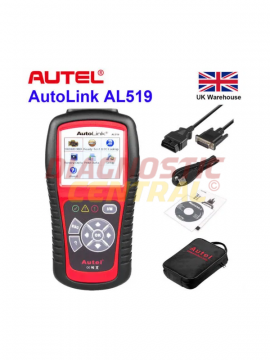
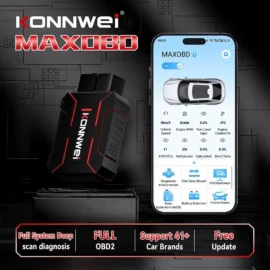
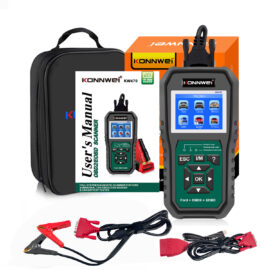
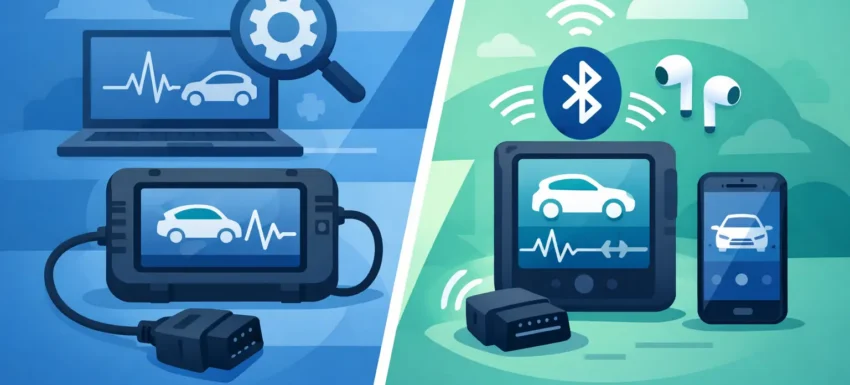
The basic difference is straightforward. A wired scanner connects directly to the vehicle’s diagnostic socket using a cable, usually through the standard 16-pin OBD2 port. A Bluetooth device plugs into the same port but sends information wirelessly to a mobile phone, tablet or, in some cases, a dedicated display.
Wired equipment normally combines the interface, screen and control buttons in one unit. It is ready to work when it is powered from the vehicle, with no pairing process, app permissions or concern over a customer’s mobile phone battery. Bluetooth systems rely on a compatible app and a stable wireless connection between the adaptor and host device.
Neither connection method alone determines whether a tool is good. The diagnostic software, supported protocols, vehicle-specific coverage and quality of the hardware matter just as much. A professional Bluetooth interface with proper manufacturer-level functions can outperform a basic wired code reader. But at the entry and mid-range end of the market, wired scanners often provide a more predictable experience for serious fault finding.
Why Wired Diagnostics Still Lead for Repeat Repairs
For garages, mobile mechanics and technicians handling several vehicles a day, reliability is usually the deciding factor. A wired connection removes one possible point of failure. There is no wireless drop-out while graphing a misfire counter, no need to reconnect after the screen sleeps, and no uncertainty over whether a mobile phone has switched to another Bluetooth device.
That matters most during jobs where live data needs watching continuously. A technician may be checking rail pressure under load, comparing oxygen sensor switching, monitoring DPF differential pressure or observing battery voltage during a cranking test. A dedicated wired tool keeps the display in the technician’s hands and the connection stable at the vehicle.
Wired units also tend to suit dirtier, faster-paced workshop conditions. Their cases, leads and physical buttons are built around regular handling, including use with gloves. A mobile phone screen is convenient, but it is easier to damage, harder to use with oily hands and often needed for calls, job management or parts ordering at the same time.
There is also a security and professionalism angle. With a wired scanner, the diagnostic session stays on a dedicated device. Customers do not need to hand over their mobile phone, install an app or connect a personal device to the vehicle. For a business, that creates a cleaner and more repeatable process.
Better access is not guaranteed, but it is common
A wired connector does not automatically grant access to every control module. Full-system diagnostics depend on the scanner and its software. However, dedicated wired tools are more commonly designed for work beyond generic engine fault codes. Depending on the model and vehicle, that can include ABS, airbag, transmission, service reset, electronic parking brake, injector coding, battery registration, steering angle calibration and other guided functions.
This is the key distinction between reading a fault and repairing the vehicle correctly. A generic OBD2 code such as P0301 tells you cylinder one has a misfire. It does not prove that the coil pack is at fault, and it may not reveal manufacturer-specific codes stored elsewhere. The right scanner gives you freeze-frame data, live values and wider module access to test the evidence before parts are fitted.
Where Bluetooth Diagnostics Make Sense
Bluetooth diagnostics have earned their place because they are compact, affordable and exceptionally convenient. A small adaptor can stay in a vehicle or toolbox, while the display is the mobile phone or tablet already in your pocket. For owners who only need periodic checks, that is a sensible arrangement.
A capable Bluetooth tool can read and erase generic powertrain codes, display live engine data and help identify why an engine management light has appeared. It is especially useful for checking a used car before purchase, watching coolant temperature, confirming charging voltage or monitoring a recurring intermittent fault. The screen on a tablet can also make graphs and data displays easier to read than a small handheld unit.
For mobile technicians, wireless working has a practical advantage too. You can sit in the driver’s seat with the mobile phone mounted securely, or stand outside the vehicle while monitoring data during an actuator test, where the system supports it. No trailing handheld scanner has to be balanced on the seat or routed through an open window.
The best Bluetooth systems can be far more than code readers. The point is to assess the complete package: adaptor quality, app support, subscription costs, supported makes and systems, update policy and the exact service functions you need. Cheap unbranded adaptors regularly create problems through poor connection quality, slow data refresh rates or incomplete protocol support. Saving a few pounds is false economy if the tool will not communicate when a vehicle is occupying a ramp.
The compromises to understand
Bluetooth depends on the mobile phone or tablet being compatible and kept updated. A change to an operating system, app subscription or device permissions can affect a tool that previously worked perfectly. Data can also be interrupted by low battery levels, wireless interference or a vehicle left with the ignition in the wrong position.
There is a further issue with leaving an adaptor permanently plugged in. Some units draw enough current over time to contribute to a flat battery, particularly on vehicles that are not used regularly. It can also make the diagnostic port more vulnerable to accidental knocks. Remove the adaptor when it is not being used unless the manufacturer specifically confirms it is suitable for permanent installation.
Diagnostic Speed Is More Than Connection Speed
It is tempting to assume wired means faster and Bluetooth means slower. In reality, the vehicle network protocol, scanner processor, app design and amount of requested data have a greater effect on speed than the cable alone. A modern Bluetooth interface can refresh selected live data quickly. A poorly designed wired scanner can still feel slow.
What wired equipment generally delivers is consistency. Switch it on, select the vehicle, read the systems and proceed. That routine saves minutes across a working day. It also reduces avoidable support issues: incorrect app settings, forgotten passwords, incompatible handsets and operating system notifications appearing just as a customer wants an answer.
For a DIY user, those minutes may not matter. For a garage, time is labour. A tool that gets straight to the fault memory and provides clear information is worth more than one that has impressive graphics but delays the job.
Choosing the Right Tool for the Job
Start with the vehicles you actually see. A petrol car owner who wants to understand an occasional dashboard warning has different requirements from an independent garage servicing mixed fleets, and both are different again from a commercial vehicle specialist working on lorries and trailers. Passenger car OBD2 equipment may not cover heavy-duty systems without the correct hardware, software and adaptor leads.
Then decide the level of diagnosis required. If the task is limited to checking generic engine codes and live values, a reputable Bluetooth solution can be effective and economical. If you need all-system scans, regular service functions, coding, adaptation or dependable use on a busy ramp, a dedicated wired scanner is usually the stronger investment.
Compatibility must be checked before purchase, particularly on newer vehicles with secure gateways and manufacturer-specific communication requirements. Do not assume that a tool which plugs into the OBD port can access every module or perform every reset. Confirm the make, model, year, engine and intended function. The same rule applies to battery testers, lorry diagnostics and specialist adaptor cables: the correct connection is part of an accurate result.
Budget should include the whole ownership picture. Consider updates, subscriptions, replacement leads, app costs and whether a tablet is required. A cheaper option that lacks the function needed on the next job is not a saving. Diagnostic Central focuses on equipment that earns its place through practical coverage and clear workshop value, rather than generic claims on a marketplace listing.
The Better Choice Depends on the Fault You Need to Find
Choose wired diagnostics when dependable connection, dedicated hardware and repeatable professional workflow matter most. It is the natural fit for garages, frequent repair work and jobs where live data, service functions or broad module access will influence the repair.
Choose Bluetooth diagnostics when portability, low entry cost and quick vehicle health checks are the priority. It can be an excellent first diagnostic tool, a useful second device for mobile work or a smart option for technically capable owners who understand its limits.
The useful tool is not the one with the longest specification. It is the one that communicates with the vehicle in front of you, gives evidence you can trust and helps you fix the fault without replacing parts on guesswork.