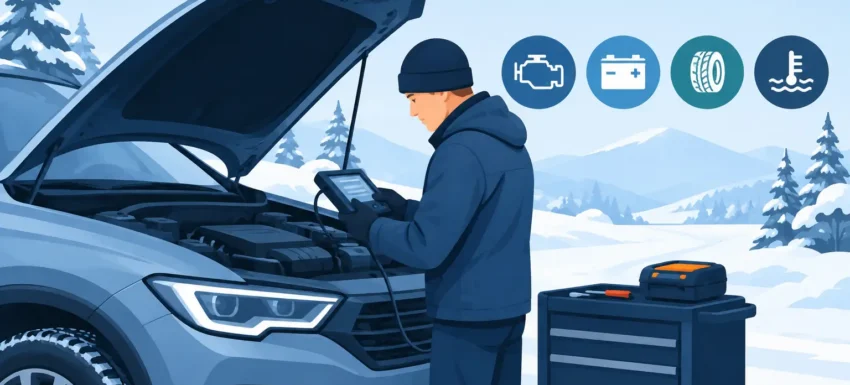
A vehicle that starts slowly on a frosty morning is not always suffering from a simple flat battery. It may have an ageing battery, a weak alternator, excessive parasitic drain or stored fault codes affecting charging management. Essential winter vehicle diagnostic checks give workshops and capable owners a clear picture before cold, darkness and wet roads turn a marginal fault into a recovery job.
Quick answer
- Test battery condition and charging voltage, not just whether the engine starts today.
- Carry out a full fault-code scan and investigate current, pending and relevant history codes.
- Check live data for coolant temperature, intake temperature and charging-system behaviour.
- Inspect tyres, lighting and electrical loads alongside electronic diagnostics.
- Confirm the scan tool supports the exact vehicle, system and service functions required.
Start with battery and charging-system evidence
Low temperature exposes weaknesses in the 12V electrical system. Engine oil is thicker, starter demand rises and a battery delivers less available power. On vehicles with stop-start, battery monitoring and smart alternator control, a basic voltage reading alone can be misleading.
Begin with a visual inspection. Check battery terminals for looseness or corrosion, inspect the earth leads and look for signs of a swollen case, leakage or an insecure battery clamp. A poor earth connection can create intermittent no-start faults, implausible sensor readings and communication errors that appear unrelated to the battery.
A proper battery tester should assess state of health, state of charge and available cranking performance against the battery type and rated capacity. Make sure the selected setting matches the fitted battery, particularly where an AGM or EFB battery is installed. Fitting or testing it as a conventional flooded battery can produce poor decisions.
Then assess the charging system with electrical loads applied. Voltage behaviour varies by vehicle because modern smart charging systems may deliberately alter alternator output according to battery condition, temperature and engine demand. The key is to compare readings with the manufacturer’s expected strategy and use scan-tool live data where supported.
A battery tester is often the fastest route to an informed result, while an OBD2 scanner that reads battery-management or body-control data can help explain why an apparently healthy battery is repeatedly undercharged. If a battery has been replaced on a vehicle requiring battery registration or adaptation, confirm that procedure has been completed where supported.
Scan every relevant control unit, not only the engine ECU
A generic code reader can retrieve standard powertrain faults, but winter complaints frequently involve systems outside the engine control unit. ABS, body control, climate control, gateway, transmission and battery-management modules may all hold useful evidence.
Run a full-system scan before clearing anything. Record codes, module status and freeze-frame information first. A low-voltage event can populate several modules with communication and sensor faults, but deleting them immediately makes it harder to separate the cause from the consequence.
Pay particular attention to faults relating to battery voltage, generator control, glow-plug circuits, coolant temperature, wheel-speed sensors, exterior lighting and CAN communication. A stored code does not automatically identify the failed part. It indicates a fault condition that needs confirmation with wiring checks, live data and, where appropriate, guided tests.
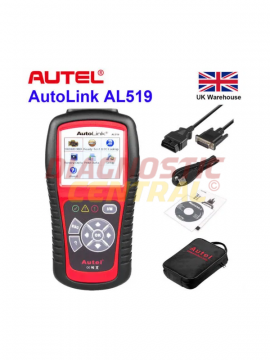
For a professional workshop, a multi-make diagnostic scanner with full-system coverage and live data can reduce guesswork considerably. For a DIY user, the right choice depends on the vehicle and the job. Check exact make, model, year, engine and required functions before assuming a tool can access service resets, battery registration, ABS data or manufacturer-specific modules.
Treat low-voltage codes with care
Undervoltage codes are common after a weak battery, repeated short journeys or jump-starting. Clear the original codes only after charging and testing the battery, then rescan after a road test. If codes return, investigate the affected circuit rather than blaming the battery by default.
This approach also avoids unnecessary replacement of alternators, sensors and control modules. Cold-weather diagnostics should be evidence-led, especially where parts are expensive or coding is required after replacement.
Use live data to catch sensors that drift in the cold
A sensor can remain electrically connected and still provide inaccurate information. Comparing live values before first start is a practical winter check because several readings should be close to ambient temperature after the vehicle has stood overnight.
Coolant temperature, intake-air temperature and outside-air temperature should be plausible and broadly consistent. A coolant sensor reporting an unrealistically warm engine can reduce fuelling enrichment on a cold start. A reading that is implausibly low or high may point to a sensor, connector, wiring fault or reference-voltage problem.
On diesel vehicles, investigate difficult cold starting methodically. Glow-plug faults, relay or control-module issues, low cranking speed, fuel-system air ingress and incorrect temperature data can all produce similar symptoms. A fault code is useful, but current draw testing and circuit checks may be needed before condemning glow plugs.
Monitor engine running data once the vehicle starts. Look for irregular idle, implausible air-flow readings, persistent regeneration requests where available and charging data that does not match operating conditions. Not every data parameter is available on every model, and names can differ between manufacturers, so use vehicle-specific information when diagnosis goes beyond basic checks.
Do not overlook tyres, brakes and lighting
Diagnostics is not limited to the diagnostic socket. Winter reliability also depends on physical checks that prevent a small electronic warning from becoming a safety issue.
Check tyre condition and pressures when tyres are cold, including the spare where fitted. Pressure falls as temperatures drop, and vehicles with tyre-pressure monitoring may illuminate a warning after the first cold spell. Reset or calibrate the system only after correcting pressures and confirming there is no puncture or damaged valve sensor.
Inspect brake discs, pads, flexible hoses and brake-fluid condition. Road salt and moisture accelerate corrosion, particularly on vehicles doing short journeys. If an ABS or stability-control warning is present, inspect wheel-speed sensor wiring and reluctor rings as well as reading fault codes. Replacing a sensor without inspecting the wiring route and wheel bearing area can waste time and parts.
Test every exterior lamp, including number-plate lights, fog lamps, brake lights and trailer socket functions where relevant. Water ingress, corroded connectors and poor earths are frequent winter faults. For commercial vehicles and towing users, appropriate lorry or trailer diagnostic adapter cables can provide access to the correct connector layout, but they do not add software coverage by themselves.
Check for parasitic drain when the battery keeps going flat
A vehicle that starts after charging but is flat again two days later needs a drain test. Common causes include interior lamps, aftermarket accessories, telematics equipment, sticking relays and modules that fail to enter sleep mode.
Allow the vehicle to lock and go to sleep before measuring quiescent current. This can take longer than expected, and opening a door or waking the network during testing invalidates the reading. A clamp meter or correctly connected multimeter is useful, but safe current-measurement technique matters because an incorrectly connected meter can blow its fuse or damage the tool.
If drain is excessive, isolate circuits carefully and use scan data to check whether modules are remaining awake. The answer is not always visible through OBD diagnostics, which is why electrical testing and an understanding of the vehicle’s network behaviour remain essential.
FAQs
Should I scan for fault codes even when no warning light is on?
Yes. Pending, manufacturer-specific and intermittent codes may be stored before a dashboard warning becomes active. They should be assessed in context, not treated as an automatic repair list.
What voltage should a healthy car battery show?
A rested conventional 12V battery commonly measures around 12.6V when fully charged, but voltage alone does not prove it can deliver enough current. Test state of health and cranking capability as well.
Can cold weather cause warning lights to appear?
It can. Reduced battery performance, moisture in connectors, tyre-pressure changes and higher electrical demand can expose existing weaknesses. The warning still needs diagnosis rather than being dismissed as weather-related.
Is a cheap OBD2 reader enough for winter checks?
It is enough for basic engine fault codes on many vehicles. It may not access ABS, battery management, service functions or manufacturer-specific live data. Choose equipment around the systems you need to test.
Do I need to register a replacement battery?
Some vehicles require battery registration, coding or adaptation, especially those with battery energy management and stop-start. Check the vehicle procedure and whether your diagnostic equipment supports the relevant function.
A winter inspection is most valuable before the first no-start, not after it. If you need help selecting suitable diagnostic equipment, contact Diagnostic Central with the registration, VIN and the functions you need, such as battery registration, full-system scanning or commercial-vehicle access. That gives you the best chance of choosing equipment that matches the vehicle and the fault-finding work ahead.