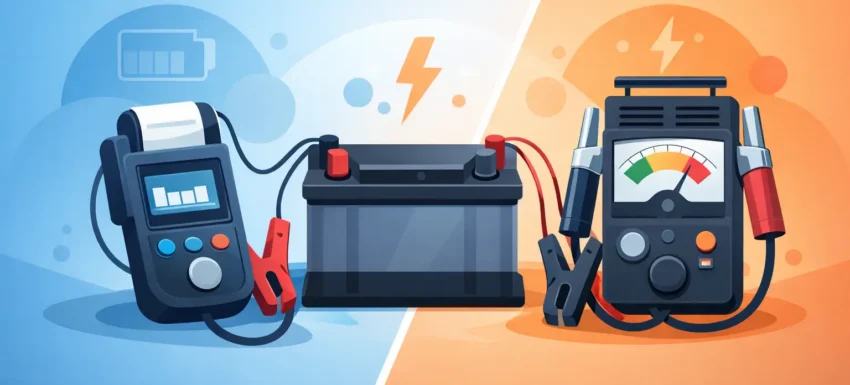
A battery that shows 12.6V and still fails to start the vehicle is where the battery analyser vs load tester debate stops being theoretical. In a workshop, on a driveway or at the roadside, the question is simple: do you want a fast pass-or-fail under demand, or do you want a clearer picture of battery condition, charging health and likely next steps?
Both tools have a place. They are not the same, they do not test in the same way, and choosing the wrong one can waste time or point you towards the wrong repair. If you work on modern vehicles with stop-start systems, AGM or EFB batteries, and power-hungry electronics, that difference matters even more.
Battery analyser vs load tester: the core difference
A load tester applies a real electrical load to the battery and watches how voltage behaves under strain. It is the older, more direct method, and many technicians still trust it because it mirrors what happens when a starter motor demands high current.
A battery analyser usually works electronically. Instead of placing the battery under a heavy discharge, it measures internal resistance or conductance and uses that data, along with battery ratings such as CCA, to estimate battery health and available cranking performance. Many analysers also test the charging system and starter circuit.
That distinction matters because the tools answer slightly different questions. A load tester asks, can this battery hold up when pushed right now? A battery analyser asks, what condition is this battery in, and how likely is it to perform properly in service?
What a load tester does well
A traditional load tester is straightforward. Clamp it on, apply the specified load, and check whether the battery voltage stays above the acceptable threshold for the test period. For older vehicles and simple workshop checks, that can still be useful.
Its strength is simplicity. If a battery collapses badly under load, you know quickly that there is a serious issue. For obvious battery failures, there is little ambiguity. On older lead-acid batteries in less electronically sensitive vehicles, it remains a practical method.
It also has a certain workshop logic behind it. Real load, real voltage drop, real answer. That is why some technicians prefer it when they want to see the battery react rather than rely on an inferred result.
The limitation is that it tells you less about the whole system, and on some modern batteries it is not the most refined approach. A heavy load test can be less suitable for deeply discharged batteries, and it does not always provide the broader diagnostic context needed when the fault may involve charging, parasitic drain or battery registration issues.
What a battery analyser does well
A battery analyser is built for speed, repeatability and wider diagnostic value. Good units can identify battery state of health, state of charge, cranking capability and alternator output without putting the battery under the same level of stress as a conventional load test.
That makes analysers especially useful for modern vehicles. If you are checking AGM, EFB or start-stop batteries, an analyser is often the more sensible first tool. It is faster for service reception checks, pre-winter inspections, used vehicle appraisals and routine workshop health reports.
It also helps when the battery is only part of the story. A customer may report slow cranking, intermittent warning lights or repeated flat battery complaints. In those cases, you need more than a basic yes-or-no result. You need evidence that separates a weak battery from a charging fault or excessive drain.
For garages, that wider view translates into less guesswork. For competent DIY users, it means clearer decisions before spending money on a replacement battery that may not actually be the root cause.
Why modern vehicles have shifted the balance
The more electronics a vehicle has, the less useful oversimplified battery testing becomes. Modern cars and vans draw power constantly, even when parked. They also rely on stable battery condition for modules, stop-start operation and fault-free communication across control systems.
That is why battery analysers have become the preferred choice in many workshops. They are better aligned with how modern battery systems are specified and maintained. Many provide battery-type selection, rated CCA input and system testing that goes beyond the battery itself.
A load tester is not obsolete, but it is no longer the full answer for most day-to-day diagnostics. If you work across newer petrol, diesel and light commercial vehicles, an analyser usually gives you more relevant information in less time.
Battery analyser vs load tester for different users
If you run an independent garage, a battery analyser is usually the smarter investment. It suits faster workflow, produces more consistent results and supports customer conversations with clearer data. When you are checking multiple vehicles a day, efficiency matters.
If you are a mobile technician, portability and speed matter even more. A compact analyser is easier to carry, quicker to use and more practical on roadside jobs or call-outs where time and battery condition may already be compromised.
If you are a DIY enthusiast maintaining one or two vehicles, the answer depends on what you need. If you want a basic check on an older car and you understand the testing method, a load tester can still do the job. If you want a safer, more informative tool for modern vehicles, a battery analyser is the better buy.
For commercial vehicle repairers, the decision depends on fleet type and battery systems. Basic load testing still has a role, but an analyser that can deal with different battery ratings and system checks is generally more useful across mixed fleets.
Where a load tester can still be the right choice
There are still situations where a load tester earns its place. Older workshop environments, older vehicles and technicians who want a direct load response may prefer it. It can also serve as a secondary confirmation tool when a battery analyser result needs verifying against real-world voltage drop under demand.
That said, it works best when the operator understands battery ratings, test conditions and limitations. Testing a partially discharged battery with the wrong expectations can give misleading results. A poor test process can make a good battery look suspect.
In other words, the tool is only as useful as the method behind it.
Where a battery analyser is the better tool
For most buyers looking at battery analyser vs load tester, the analyser comes out ahead because it suits the way vehicles are diagnosed now. It is the better option when you need quick checks, battery health estimates, charging system insight and compatibility with newer battery technologies.
It is also easier to integrate into service work. A proper battery report helps justify battery replacement, identify charging issues and build trust with customers who want evidence rather than opinion. That matters whether you are advising on a family hatchback or maintaining a hard-worked van fleet.
From a sales and service point of view, a battery analyser is simply more versatile. One tool can support battery testing, alternator checks and starter analysis without adding unnecessary complexity.
The trade-off: direct load versus diagnostic detail
This is where the choice becomes practical rather than ideological. A load tester gives you a direct stress test. A battery analyser gives you more detail with less battery strain. Neither is automatically better in every single case.
If your work is mainly on older vehicles and you want a low-tech method, a load tester may be enough. If your work includes start-stop systems, regular battery replacements, charging complaints or fleet servicing, an analyser is the stronger long-term tool.
The biggest mistake is treating them as interchangeable. They overlap, but they do not replace each other perfectly. One is focused on loaded performance in the moment. The other is designed to assess condition and system behaviour with more precision.
What to look for before you buy
Do not choose on price alone. Choose based on the vehicles you actually see and the level of diagnostic confidence you need.
If you are buying a battery analyser, check supported battery types, test standards, CCA range, charging and starter test functions, and whether the display gives clear guidance rather than vague readings. Ease of use matters in a busy workshop.
If you are buying a load tester, focus on build quality, clamp quality, current capability and whether it is suitable for your battery sizes and working environment. Cheap units can introduce more doubt than clarity.
This is one area where specialist supply matters. Buying from a diagnostics-focused retailer such as Diagnostic Central makes more sense than gambling on generic tools with unclear specs and no real technical backing.
So which one should you choose?
For most UK garages, mobile technicians and serious DIY users, a battery analyser is the better all-round choice. It is faster, more informative and better suited to modern vehicle electrical systems. It reduces guesswork and helps you diagnose the battery, starter and charging circuit as part of one process.
A load tester still has value, especially on older vehicles or as a straightforward confirmation tool, but it is no longer the first choice for every job. If you need one tool that earns its keep across a broad range of vehicles, the analyser is usually the one to buy first.
The best battery test is not the one that feels traditional. It is the one that gives you a reliable answer quickly enough to keep the job moving.