A battery that is flat after a night or two, yet starts reliably once charged, often points to an excessive key-off current draw. Learning how to diagnose parasitic drain properly stops the usual cycle of replacing a battery, fitting an alternator and hoping for the best. The fault may be as simple as a glovebox lamp, or it may be a control module repeatedly waking the vehicle network.
Quick answer:
- Confirm the battery is charged, serviceable and correctly rated before chasing a drain.
- Let the vehicle enter sleep mode, then measure key-off current with a suitable meter or DC current clamp.
- Compare the reading with the manufacturer’s specification rather than relying on one universal figure.
- Isolate the affected circuit methodically, using fuse voltage drop testing where possible.
- Check for common non-fuse causes, including alternator diode leakage, relays and aftermarket accessories.
Start by proving the battery is not the problem
A parasitic drain test is only meaningful when the battery itself is in good condition. A weak battery can lose enough usable capacity overnight to mimic a current drain, particularly in cold UK weather. Equally, a battery that has repeatedly been deeply discharged may accept a surface charge but fail under load.
Charge the battery fully with an appropriate charger, then assess its condition with a battery tester. Check its resting voltage after it has stood, its available cold cranking performance and, where the tester supports it, its state of health. Also inspect the terminals, earth leads and main positive connections for looseness, corrosion or heat damage.
A charging-system check belongs here too. With the engine running, confirm the alternator is charging within the vehicle manufacturer’s expected range. An alternator can charge normally yet still leak current through a failed rectifier diode when the engine is off, so a good charging voltage does not completely clear it.
What counts as an excessive parasitic drain?
There is no one reading that suits every vehicle. Older cars with limited electronics may settle at around 20-50 mA. Many newer vehicles can legitimately use more while alarm systems, telematics, keyless entry, battery monitoring and convenience modules remain on standby. Some premium or commercial vehicles have longer sleep routines and higher specified quiescent current.
The key word is settle. A car can draw several amps immediately after the ignition is switched off because modules are saving data, cooling fans are running, or the infotainment system is shutting down. That is not automatically a fault. The current needs to be measured only after the vehicle has completed its normal sleep cycle, which may take 20 minutes, 45 minutes or longer depending on the model.
Use workshop data for the exact vehicle wherever possible. If no specification is available, an established draw in the tens of milliamps is usually more credible than one in the hundreds. A stable 300 mA draw, for example, can flatten a modest battery surprisingly quickly.
How to diagnose parasitic drain without waking the vehicle
Preparation determines whether this test gives a useful answer. Park safely, switch off all accessories and remove the key or key fob from the vehicle’s detection range. On keyless vehicles, keep the fob well away from the car. Repeatedly approaching the vehicle with the key can wake body-control modules and invalidate the result.
Open the bonnet and arrange access to the battery and fuse boxes before starting. If the battery is in the boot, latch the boot catch with a screwdriver so the vehicle believes it is closed, while keeping a safe route to release it afterwards. Do the same for the bonnet latch if the vehicle design requires it. Take care not to lock the keys inside.
Close all doors or latch their catches. Switch interior lamps off manually if required. Avoid operating the central locking, infotainment screen or diagnostic socket during the settling period unless your chosen procedure specifically requires it. Even a door opening can restart the sleep timer.
Choose the right way to measure current
A DC low-current clamp meter is often the least disruptive option. Clamp it around a single battery cable, not both cables together, and zero it as instructed by the meter manufacturer. A clamp lets you observe current without disconnecting the battery, which reduces the risk of resetting modules or losing radio codes. Its limitation is resolution: not every clamp reads low milliamps accurately enough for modern vehicle standby current.
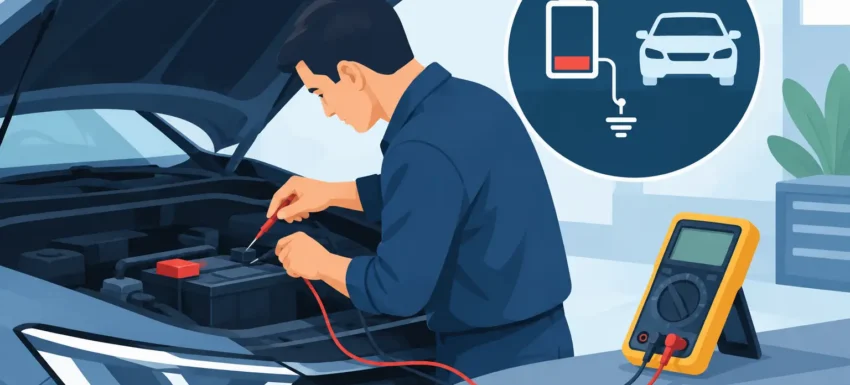
A quality automotive multimeter can give a more precise reading, but it must be used in series with the battery circuit. Start on the highest current range, use the correct fused input terminal and follow the meter’s stated current limit. Never attempt to crank the engine, operate high-current equipment or start charging while the meter is connected in series. Doing so can blow the meter fuse or damage the meter.
A practical method is to connect the meter between the negative battery terminal and the disconnected negative cable. This avoids working directly at the main positive supply. Make the connection securely, then leave the vehicle undisturbed until the current has settled. If disconnecting the cable wakes the vehicle, use a temporary bypass lead while fitting the meter, then remove the bypass once the connection is stable.
Record the draw and wait for sleep mode
Watch the meter rather than taking the first reading as fact. You may see the current step down in stages as separate modules time out. Record the initial reading, the time elapsed and the final stable reading. This creates a useful job record and prevents confusion when a customer reports an intermittent flat-battery complaint.
If the draw remains high, do not immediately pull fuses at random. Removing a fuse can wake modules, create fault codes or temporarily stop a circuit that only appears guilty because another module has been disturbed. Methodical isolation is quicker and more defensible.
Isolate the circuit causing the drain
Where fuse information and access allow, voltage-drop testing across fuses is often the preferred approach. With current flowing through a fuse, a small voltage drop develops across it. Measuring that drop can identify which protected circuits are carrying current without removing the fuse and waking the vehicle. You will need a fuse voltage-drop reference chart or circuit data that relates the measured millivolts to current for the specific fuse type.
If a voltage-drop method is not practical, remove and refit one fuse at a time while monitoring the current draw. Wait after each change for the network to settle again. When the draw falls sharply, note the fuse number, its rating and every component on that circuit. The fuse identifies a branch of the system, not necessarily the failed part.
Then narrow the fault down using wiring diagrams and component checks. Common offenders include a sticking relay, boot or glovebox lamp, door latch switch, powered towbar module, dash camera hardwire kit, aftermarket tracker, amplifier, charger socket, alarm or water-damaged control unit. On vans and lorries, body-builder equipment, auxiliary batteries and trailer circuits deserve particular attention.
Do not overlook the alternator and unfused feeds
Not every drain passes through a conventional passenger-compartment fuse box. An alternator with a leaking diode can feed current back through the main charging cable. Disconnecting or isolating the alternator feed for test purposes can confirm the direction of investigation, but follow the manufacturer procedure and avoid shorting a live B+ terminal.
Also consider high-current fused feeds, under-bonnet fuse boxes, battery monitoring sensors and add-on wiring connected directly to the battery. A corroded connector can create unexpected module behaviour, while a poorly installed accessory may stay permanently live.
Use a scan tool to understand module activity
An OBD diagnostic scanner does not replace a current measurement, but it can make the next stage much faster. Scan all available modules for fault codes, communication errors and low-voltage history. Repeated CAN communication faults, door-ajar faults or battery-management codes can point towards a module that is refusing to sleep or being woken by another controller.
Where supported by the vehicle and scan tool, live data may show door status, bonnet status, terminal state, battery sensor values and network sleep or wake information. This is particularly useful when the current drain is intermittent. Check exact vehicle coverage and the required special functions before relying on any scanner for body-module diagnostics.
For recurring battery complaints, a battery tester combined with a capable diagnostic scanner is usually a stronger workshop setup than either tool alone. The tester confirms battery condition; the scanner adds system context; a multimeter or suitable clamp proves the actual draw.
FAQs
Can a parasitic drain flatten a battery overnight?
Yes. It depends on battery capacity, state of health, ambient temperature and the size of the draw. A large drain can flatten a battery overnight, while a smaller but persistent draw may take several days.
Is it safe to disconnect the battery to test for a drain?
It can be, but disconnecting the battery may reset vehicle systems, trigger security procedures or wake modules when it is reconnected. Use the correct procedure for the vehicle and preserve settings only where this does not interfere with the test.
Can a faulty alternator cause battery drain when parked?
Yes. A failed rectifier diode can allow current to flow back through the alternator when the engine is switched off. This is a common possibility when fuse testing does not reveal the source.
Why does my current reading keep changing?
Modern vehicles wake and sleep in stages. Keyless entry, telematics, alarms, periodic network checks and an open door or bonnet can all alter the reading. Ensure the vehicle is undisturbed and allow sufficient time before judging the result.
A flat battery is a symptom, not a diagnosis. If you need help choosing a battery tester, multimeter, clamp meter or scan tool for a specific job, contact Diagnostic Central with the registration, VIN and the functions you require. The right test equipment, used in the right order, turns an intermittent electrical complaint into a traceable repair.