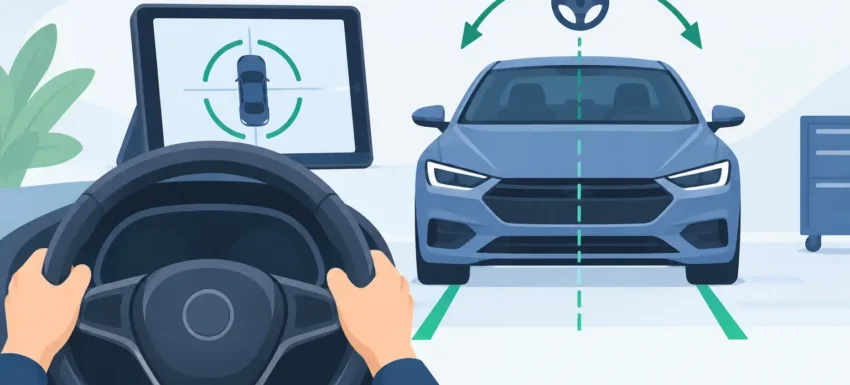
A steering wheel that sits straight is not proof that the vehicle knows it is travelling straight. If the steering angle sensor has lost its learned centre point, ABS, ESP, traction control, electric power steering or driver-assistance functions can log faults or behave unpredictably. Knowing how to calibrate steering angle correctly is therefore a diagnostic task, not simply a matter of clearing a warning light.
Quick answer
- Correct the wheel alignment and any steering or suspension faults before starting.
- Keep the front wheels straight, steering wheel centred and vehicle on level ground.
- Use a diagnostic tool that supports steering angle sensor calibration for the exact vehicle.
- Follow the scan tool prompts precisely, then confirm live steering-angle data and fault-code status.
What steering angle calibration actually does
The steering angle sensor, often abbreviated to SAS, measures the steering wheel’s position, direction and rate of movement. Its data is shared with systems such as ABS, electronic stability programme, traction control, electric power steering and, on some vehicles, lane-assist or parking functions.
Calibration teaches the relevant control unit where the straight-ahead position is. Depending on the make and system, this may be called steering angle sensor zero point calibration, neutral position reset, centre position learning, SAS initialisation or basic setting.
It does not physically adjust the tracking, straighten a crooked steering wheel or repair worn steering components. If the toe setting is incorrect, a track-rod end is loose, the subframe has shifted or the steering wheel has been refitted off-centre, calibration can store a false reference point. That may turn off a warning lamp temporarily, but it is not a proper repair.
When a steering angle sensor needs calibrating
A calibration is commonly required after wheel alignment, steering rack replacement, steering column or clock spring work, steering angle sensor replacement, certain battery or module repairs, or accident damage repairs. It may also be necessary following a flat battery if the vehicle has stored related faults or lost learned values.
The exact requirement depends on the vehicle. Some cars retain their steering-angle reference after battery disconnection, while others require a relearn procedure. Equally, a warning lamp does not always mean calibration is the answer. A stored fault for an implausible signal, communication failure, internal sensor defect or low supply voltage needs diagnosis before any reset is attempted.
A typical symptom is an ABS, ESP, traction-control or power-steering warning after alignment, even though the car drives normally. Other signs include stability control intervening unexpectedly, a steering-wheel warning symbol, or live data showing several degrees of angle with the wheels visibly straight.
Before you calibrate: get the mechanical basics right
The vehicle must be mechanically correct first. Set tyre pressures to specification, inspect tyres for obvious damage or major size differences, and ensure the steering and suspension have no excessive play. The front wheels should be aligned properly, not just made to look straight by adjusting one track rod.
Park on level, solid ground with the vehicle unloaded where practical. Centre the steering wheel and confirm the road wheels point straight ahead. A wheel clamp or alignment equipment is useful in a workshop, but careful visual checks can be adequate for some basic procedures. If the steering wheel is visibly offset after a proper alignment, rectify that before setting the sensor zero.
Battery voltage matters. Low voltage can interrupt a calibration or create fresh communication faults. Connect a suitable stabilised battery support unit if the manufacturer procedure requires the ignition on for an extended period. Avoid relying on a weak battery charger that cannot maintain voltage under vehicle load.
Read all fault codes before clearing anything. Record codes from ABS, steering, gateway and driver-assistance modules, as well as the engine ECU where relevant. Existing wheel-speed sensor faults, steering motor faults or CAN communication problems can prevent the basic setting from completing.
How to calibrate steering angle with a diagnostic scanner
The menu names vary, but the workshop process is broadly similar.
1. Connect a compatible tool and identify the vehicle
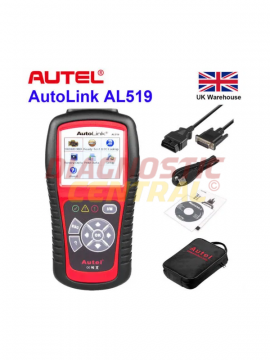
Connect the diagnostic scanner to the OBD socket and select the vehicle manually or through automatic VIN identification. Enter the ABS/ESC, steering, chassis or relevant gateway control unit. Do not assume a generic engine-code reader can perform this function. Many basic OBD2 readers can read standard emissions faults but cannot access manufacturer-specific calibration routines.
For regular workshop use, a professional multi-make diagnostic scanner with service functions and live data is the practical choice. Brand-specific diagnostic modules can be a better fit where a garage mainly works on one manufacturer group and needs deeper access. Check the advertised coverage against the vehicle’s model year, control system and required steering-angle function before buying.
2. Check live steering-angle data
Before starting the routine, view the live steering-angle value with the wheels straight. A small variation can occur between systems, but a reading that is significantly offset indicates either a lost reference, a mechanical centring issue or an incorrect sensor signal.
Also inspect wheel-speed data where available. All four wheel speeds should be plausible and no related chassis-system faults should be active. If the scan tool reports a steering-angle value that jumps, drops out or remains fixed while the wheel is moved, investigate the sensor, clock spring, wiring or steering-column electronics rather than forcing a calibration.
3. Start the calibration or basic setting
Select the steering angle calibration, zero-point calibration or basic setting function. Most tools will instruct you to keep the wheels straight and the steering wheel untouched. Some vehicles require the ignition on with the engine stopped; others require the engine running, the parking brake applied or a specific gear position. Follow the on-screen instructions for that vehicle, not a procedure remembered from another make.
The tool may write the centre position immediately, or it may ask you to turn the steering wheel from lock to lock, return it to centre and confirm. Do not force the steering against the end stops. Turn smoothly and stop when the procedure tells you to do so.
4. Clear codes and prove the repair
Once the scanner reports a successful calibration, clear relevant fault codes if the procedure permits. Cycle the ignition, then recheck live data with the wheels straight. The steering-angle reading should now be close to zero or within the manufacturer’s stated tolerance.
Carry out a controlled road test where safe and appropriate. Check that warning lamps remain off, steering assistance feels normal and stability-control warnings do not return. Some vehicles need a short straight-line drive above a specified speed before all warning indicators extinguish. Re-scan afterwards to confirm that no fault codes have returned.
Why calibration can fail
A failed routine is useful diagnostic information. Do not repeatedly run the reset in the hope it will eventually complete. Common causes include wheels not being straight, a steering wheel that is mechanically off-centre, incorrect alignment, low battery voltage, active ABS or wheel-speed faults, an unsupported scanner function, or a defective steering angle sensor.
There is also a difference between access and capability. A tool may communicate with the ABS module and display steering-angle data but still lack the coding or guided calibration required for a particular vehicle. This is particularly relevant on newer vehicles with secure gateways, online functions or manufacturer-controlled diagnostic access.
If calibration completes but the warning returns, read the fault code again rather than assuming the sensor is at fault. A recurring code may point to a wheel-speed sensor, yaw-rate sensor, steering rack module, clock spring or wiring issue. The diagnostic route depends on the exact code, freeze-frame information and live data.
Steering angle calibration is not ADAS calibration
A steering-angle reset can be part of a wider repair after alignment or chassis work, but it is not a substitute for camera or radar calibration. If a vehicle has lane assist, adaptive cruise control, emergency braking or parking assistance, separate ADAS calibration may be required after collision repairs, geometry changes or sensor removal.
Likewise, calibrating the steering sensor cannot correct a thrust-angle problem at the rear axle. A four-wheel alignment check is the right next step when the vehicle crabs, the steering wheel cannot be centred correctly, or tyre wear suggests a rear-geometry issue.
Choosing equipment for the job
For occasional competent DIY use, select an OBD2 diagnostic scanner that specifically lists steering angle calibration or relevant service functions for the intended vehicle. For an independent garage, deeper multi-make diagnostics with ABS, steering, coding and guided functions will save time across a wider range of vehicles. Battery support equipment is also worthwhile when carrying out module programming, adaptations or prolonged diagnostics.
Compatibility should always be checked before purchase. Vehicle year, chassis code, installed ABS unit and security requirements can all affect whether a function is available. Diagnostic Central can help identify suitable equipment when you provide the registration or VIN, vehicle details and the exact functions you need.
FAQs
Can I calibrate a steering angle sensor without a scanner?
Some older vehicles use a manual lock-to-lock or drive-cycle relearn, but many require a manufacturer-capable diagnostic tool. Check the repair information for the exact vehicle before attempting a manual method.
Should I calibrate the sensor before or after wheel alignment?
After alignment. The wheel geometry and steering wheel position must be correct before the zero point is stored.
Will disconnecting the battery reset the steering angle sensor?
Usually not in a useful way. It may create faults or cause some systems to request a relearn, but battery disconnection is not a reliable calibration procedure.
Is it safe to drive with a steering angle sensor fault?
The vehicle may still steer normally, but stability control, traction control, power steering assistance or ADAS functions may be reduced or unavailable. Diagnose it promptly, particularly if warning lamps are illuminated.
A successful steering-angle calibration should be the final confirmation of a mechanically sound repair, not a shortcut around one. If you are selecting equipment for the task, have the registration or VIN, model year and required functions ready before contacting Diagnostic Central.