A camera that is a few millimetres out of position can leave a customer with lane assist, emergency braking or traffic-sign recognition that no longer performs as intended. That is why an ADAS calibration equipment buyers guide needs to start with the work you actually undertake, not the biggest target board in a catalogue. The right setup must match the vehicles, systems and calibration procedures your workshop supports.
Quick answer
- Buy for your regular vehicle parc and planned work, rather than claimed coverage alone.
- Static calibration needs accurate targets, measured positioning and enough level workshop space.
- Dynamic calibration can reduce hardware costs, but it is not a substitute where the manufacturer requires a static procedure.
- A capable diagnostic tool is essential for guided functions, fault checks and confirming completion where supported.
- Check subscriptions, target updates, vehicle coverage and training requirements before committing.
Why ADAS calibration equipment has become a workshop decision
Advanced driver assistance systems are no longer limited to premium vehicles. Forward-facing cameras, radar sensors, ultrasonic parking systems and driver-monitoring functions are fitted across everyday cars, vans and, increasingly, light commercial vehicles. A windscreen replacement, bumper repair, wheel alignment, suspension repair or collision repair can trigger a calibration requirement.
For an independent garage, sending every job elsewhere costs time, margin and customer confidence. However, buying equipment without understanding the process creates another problem: an expensive frame and a diagnostic tablet cannot make an unsuitable bay level, provide the correct target, or override a vehicle-specific procedure.
Start by reviewing the jobs you already see. If your business handles alignments, windscreens, body repairs or steering and suspension work, ADAS capability may be a logical addition. If you mainly carry out servicing and mechanical repair, a strong diagnostic platform with ADAS coverage may be the sensible first step, with calibration referred out until demand supports a full setup.
Static, dynamic and dual-method calibration
The manufacturer repair information determines the required method. There is no universal rule that one method is better.
Static calibration
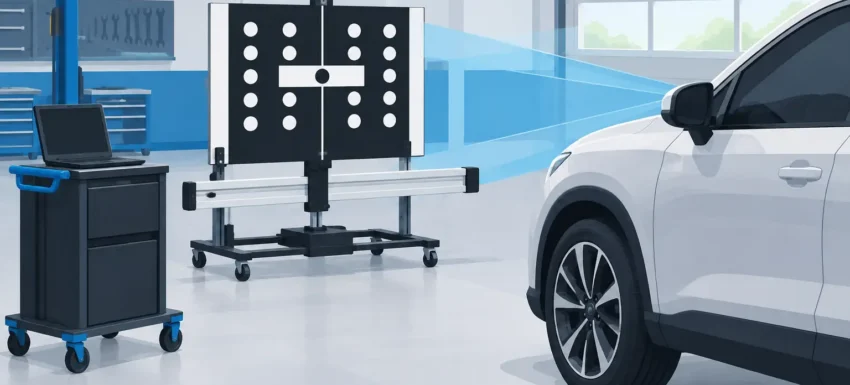
Static calibration is performed in the workshop using physical targets placed at exact distances, heights and centre lines from the vehicle. Depending on the vehicle, this may involve a camera chart, radar reflector, laser alignment equipment or brand-specific panels.
It is generally the more demanding option for premises and setup accuracy. Your floor must be suitably level, lighting needs to be controlled where the procedure requires it, tyre pressures and ride height must be correct, and the vehicle’s thrust angle may need checking before calibration begins. The advantage is that static systems can cover procedures that cannot be completed on the road and offer a repeatable process when properly installed.
Dynamic calibration
Dynamic calibration uses a guided drive cycle. The diagnostic tool places the system into calibration mode, then the vehicle is driven at stated speeds and under specified road conditions until it learns or verifies its reference point.
It can be practical for mobile technicians and smaller garages, but only where the vehicle supports it. Safe road access, clear lane markings, suitable weather, traffic conditions and a fully charged battery can all affect whether the procedure completes. A dynamic-capable scanner does not mean every camera or radar can be calibrated dynamically.
Dual-method systems
Many professional systems support both methods. This gives a workshop flexibility, but it does not remove the need for targets or space. Choose dual-method capability if the makes you service use a mixture of procedures, particularly if you work on newer vehicles from several manufacturers.
Match the equipment to your vehicle mix
Coverage claims need careful reading. “Multimake” does not always mean every model, year, engine variant and ADAS control unit is included. Functions can also vary by software version, region and fitted option.
Before buying, create a short list of your most common makes and at least ten recent registrations or VINs. Ask whether the exact calibration functions are supported and whether the required targets are included, optional or unavailable. This is especially important for BMW, Mercedes-Benz, Volkswagen Group, Ford, Toyota and newer EV platforms, where specifications can change within a model range.
For workshops handling vans, check light commercial coverage separately. A system that is excellent on passenger cars may have limited procedures for Transits, Sprinters, Crafters or Stellantis vans. Lorry and trailer work can require a different level of diagnostic hardware and dedicated commercial vehicle software.
The core parts of a professional setup
A workable ADAS bay is a system, not a single purchase. Most workshops need four connected elements:
- A diagnostic scan tool with guided calibration software and current vehicle coverage.
- A calibration frame or aiming system that can be accurately centred and measured.
- The correct targets, reflectors and adaptors for the vehicles being calibrated.
- Wheel alignment and workshop measuring equipment capable of confirming the vehicle is mechanically ready.
The diagnostic tool is the control point. It reads and clears relevant fault codes, checks preconditions, communicates with the ADAS module and reports whether the procedure has completed. Look for clear live data, service functions and guided instructions, but remember that prompts do not replace manufacturer repair information or technician judgement.
Frame quality matters because repeatability matters. A cheaper manual frame can be a sound choice for a lower-volume workshop if it is stable, accurately scaled and used carefully. Camera-guided or digital measuring systems speed up positioning and can reduce operator error, particularly where multiple technicians use the equipment each day. They cost more, so the value depends on calibration volume and labour rate.
Targets are where apparently similar packages often differ. Some entry packages cover common camera patterns but require extra boards for radar, night vision or certain manufacturer systems. Ask for an itemised target list and factor in the cost of future additions. A lower initial price is not necessarily lower ownership cost.
Do not overlook the workshop bay
A calibration system is only as accurate as the environment around it. Measure the available area before ordering. You need room ahead of the vehicle for the frame and targets, clearance to move and measure safely, plus a stable, reasonably level floor.
Poor lighting, reflective surfaces, uneven floors and clutter can disrupt camera-based procedures. A dedicated bay is ideal for busy workshops because it prevents staff from moving targets or interrupting a setup. Smaller premises can still calibrate successfully, but they must choose equipment and procedures that suit the space rather than forcing a large-frame system into an unsuitable area.
Preparation is equally important. Confirm tyre condition and pressures, correct wheel alignment where required, vehicle ride height, fuel level or load condition, steering angle sensor status and battery support. Calibrating a vehicle with underlying faults or incorrect geometry can produce a completed screen result without resolving the real cause.
Software, updates and ownership costs
The purchase price is only one part of the calculation. Ask about annual software subscriptions, calibration database updates, target additions, technical support, training and replacement parts. A system with a lower entry cost but weak update support can become restrictive as vehicle technology changes.
Also check whether calibration reports can be saved or printed. For bodyshops, insurance-related repairs and fleet customers, evidence of pre-scan, repair work and post-calibration results can be commercially valuable. Reports are useful records, but they should show what was actually completed, not be treated as a guarantee that every road condition has been replicated.
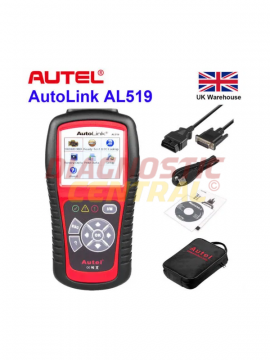
Diagnostic Central’s specialist diagnostic equipment range can suit garages building their capability in stages, from advanced scan tools for ADAS fault finding to workshop-focused calibration solutions where the required vehicle functions are supported. The practical choice depends on your vehicle mix, available bay and expected job volume.
Common buying mistakes
The most expensive mistake is assuming that a scanner alone performs calibration. It may initiate the routine and support dynamic relearns, but static procedures need the correct physical references. Another common error is buying universal targets without verifying the makes and systems they cover.
Avoid choosing solely on the number of targets in a package. A workshop that mainly services common UK fleet vehicles may get a better return from accurate coverage of its core makes than from a broad collection of rarely used boards. Equally, do not underestimate training. Technicians need to understand sensor placement, geometry, vehicle preconditions and when to stop rather than force a procedure through.
FAQs about ADAS calibration equipment
Can I calibrate ADAS after every wheel alignment?
Not automatically. Some vehicles require calibration after geometry adjustment, steering or suspension repairs, while others do not. Check the manufacturer procedure for the exact vehicle and system. If alignment values are incorrect, correct them before attempting calibration.
Do I need a perfectly level floor?
Requirements vary by manufacturer and equipment type, but a level, measured working area is critical for reliable static calibration. Some systems can compensate within stated limits. Do not assume compensation makes an uneven or damaged floor acceptable.
Is a dynamic calibration drive enough?
Only where the manufacturer specifies a dynamic procedure. Certain systems need static targets first, while others require static and dynamic stages. The scan tool’s guided process should be followed exactly.
Can a competent DIY user buy ADAS calibration equipment?
They can, but the cost, space and accuracy requirements make full static systems better suited to professional workshops. A capable DIY user may benefit more from a diagnostic tool for fault reading and pre-checks, then use a calibration specialist where required.
How often should calibration equipment be checked?
Inspect frames, measuring scales, target condition and software status regularly. If equipment is knocked, moved frequently or used heavily, check its alignment and manufacturer maintenance guidance before relying on it for a customer vehicle.
Before you buy, gather a few registrations or VINs, list the ADAS functions you need to cover and measure your available bay. Contact Diagnostic Central with those details and the required functions, and the team can help you narrow the choice to equipment that fits the work you intend to bring in-house.