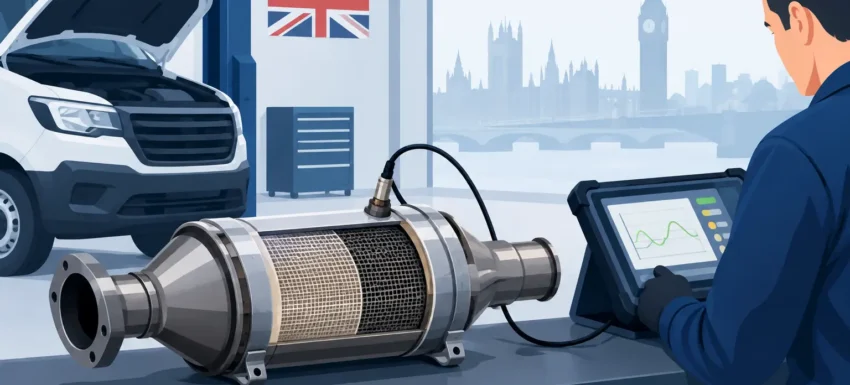
A DPF warning light does not automatically mean the filter needs replacing. This diesel particulate filter testing guide explains how to separate a genuinely restricted filter from the sensor, temperature, driving-pattern and engine faults that commonly prevent regeneration. Getting that distinction right can save a customer from an unnecessary four-figure repair and stops a workshop wasting time on a forced regeneration that was never going to complete.
Quick answer
- Start with a full-system fault-code scan, not the engine ECU alone.
- Compare live DPF differential pressure, calculated soot load, ash load and exhaust temperatures against the vehicle’s specified data.
- Check pressure pipes, sensors, EGR operation, boost control and injector-related faults before condemning the filter.
- Only carry out a stationary or road regeneration when the scan data and vehicle conditions show it is safe and appropriate.
What DPF testing is trying to prove
A diesel particulate filter traps soot produced during normal combustion. The engine management system periodically raises exhaust temperature to burn that soot away during regeneration. Ash, however, is a non-combustible residue from engine oil additives and fuel-borne deposits. It remains in the filter and slowly reduces its available capacity over the vehicle’s life.
Testing therefore has two jobs. First, establish whether soot loading is high and whether regeneration has been inhibited. Second, establish whether the filter is physically restricted by ash or damaged internally. A scan tool may report a high calculated soot figure, but that value is influenced by the ECU’s model and the signals it receives. It is useful diagnostic evidence, not a replacement for checking the system around it.
A vehicle used mainly for short, low-speed runs is a common candidate for incomplete regeneration. Yet repeated failed regenerations can also point to a thermostat that runs cool, an exhaust temperature sensor reading implausibly, a split differential-pressure hose, excessive EGR flow, a boost leak or an engine producing too much soot. The same dashboard message can hide very different repairs.
Diesel particulate filter testing guide: the correct order
Read codes and freeze-frame information first
Use a capable diagnostic scanner to perform a complete vehicle scan, then enter the engine management system and record stored, pending and permanent codes. Do not clear them immediately. Freeze-frame data may show coolant temperature, vehicle speed, engine load and exhaust values at the moment the fault was recognised.
Pay particular attention to faults relating to differential pressure, exhaust gas temperature, intake air flow, EGR, boost pressure, injectors, glow plugs and fuel additive systems where fitted. On some makes, even a separate fault in a relevant system will inhibit active regeneration. Generic OBD2 code reading is useful for an initial check, but make-specific live data and service functions are often needed for a reliable DPF assessment.
Check the basic operating conditions
Before testing the DPF itself, confirm that the engine reaches and holds its normal operating temperature. A thermostat stuck open can leave coolant temperature too low for the ECU to authorise regeneration. Check oil level too. If it is overfilled or smells strongly of diesel, fuel dilution from interrupted regeneration may be present, and the oil may need changing before further work.
Inspect the air filter, intake pipework and visible exhaust joints. Look closely at the DPF pressure sensor hoses. They can crack, soften, block with soot or be connected incorrectly after previous work. A blocked pipe can create a false high-pressure reading; a split pipe can produce an implausibly low reading. Either fault can make a serviceable filter look defective.
Assess live DPF data at idle and under load
With the engine fully warm, view live data rather than relying on a single fault description. Exact parameter names differ by manufacturer, but the most useful values are typically differential pressure, calculated soot mass or percentage, estimated ash load, distance or time since the last regeneration, regeneration status and exhaust gas temperatures.
A healthy system generally shows low differential pressure at warm idle and a progressive increase as engine speed and load rise. There is no universal pressure figure that condemns every DPF. Filter size, engine displacement, sensor scaling and ECU strategy vary widely, so compare readings with manufacturer information for the exact vehicle whenever possible.
The pattern matters more than one number. High pressure at idle that rises sharply with engine speed can indicate a restricted filter. A reading that is fixed, negative, implausibly high before start-up or unchanged when revved points more strongly to a pressure sensor, wiring or hose issue. If the scanner supports graphing, record the signal during a controlled road test. This gives far better evidence than checking at idle alone.
Exhaust gas temperature sensors also need to behave logically. During an active regeneration, temperatures upstream of the DPF should rise substantially, with the expected relationship between sensors depending on their location. A sensor that remains fixed, jumps erratically or disagrees with a cold engine condition can prevent regeneration or make the ECU abandon it.
Separate soot loading from ash loading
High calculated soot load may be recoverable through a successful regeneration if the filter is intact, no inhibiting faults are present and the ECU permits the procedure. High ash load is different. Regeneration does not remove ash. Depending on filter condition and the manufacturer’s limits, professional off-car cleaning or DPF replacement may be the correct route.
Be cautious with any reported ash value. Many ECUs estimate it from fuel use, mileage and regeneration history rather than measuring it directly. It should be judged alongside differential pressure, service history and the vehicle’s response under load. A filter with a high ash estimate but low, plausible pressure readings may not yet be the immediate cause of the complaint.
Decide whether regeneration is appropriate
A guided or forced regeneration is a repair procedure, not a diagnostic shortcut. Run it only after resolving relevant fault codes, checking oil condition and ensuring the exhaust system is sound. Follow the diagnostic tool prompts exactly and carry it out in a suitable, well-ventilated area, clear of combustible materials. Exhaust temperatures become extremely high.
Where supported, a diagnostic tool can show regeneration preconditions and command a service regeneration. This is valuable when used with live data, but it cannot repair a cracked DPF substrate, a defective temperature sensor or an engine fault creating abnormal soot. If differential pressure remains excessive after a completed regeneration, further investigation is required rather than repeated attempts.
When a road test gives the clearest answer
A controlled road test is often the most useful final check. Log DPF pressure, calculated soot load, exhaust temperatures, boost pressure and EGR-related values while accelerating under moderate load. It can reveal a restriction that is less obvious when the vehicle is stationary, while also exposing boost or airflow faults that contribute to smoke and soot production.
Choose a safe route and avoid chasing data at the expense of road conditions. For professional work, save the pre- and post-repair readings to the job record. They demonstrate why a regeneration, sensor repair, clean or replacement was recommended and give a useful baseline if the vehicle returns.
Choosing equipment for DPF diagnosis
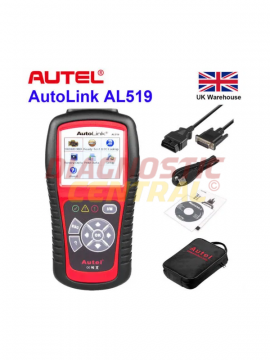
For occasional checks, a reliable scanner that reads manufacturer live data may be sufficient, provided it supports the exact vehicle. For workshop use, look for make coverage, live-data graphing, fault-code freeze frames, service regeneration functions where supported, and the ability to view multiple parameters at once. A dedicated differential-pressure gauge can be a worthwhile second opinion when electronic readings do not match the symptoms.
Diagnostic Central supplies diagnostic equipment for passenger vehicles and commercial applications, but compatibility is never automatic. Check the vehicle’s make, model, year, engine and required DPF functions before buying. A tool may read generic codes yet not offer guided regeneration, ash reset procedures or full manufacturer data on every system.
Frequently asked questions
Can I test a DPF without removing it?
Yes. Most faults can be assessed in situ using fault codes, live pressure readings, exhaust temperatures, calculated loading values and a road test. Removal is normally reserved for cleaning, inspection or replacement when the evidence supports it.
Does a high soot value always mean the DPF is blocked?
No. The value may be calculated from ECU inputs and can be distorted by sensor faults, interrupted regenerations or engine problems. Confirm it with differential-pressure behaviour and the wider live-data picture.
Can I force a regeneration with the warning light on?
Sometimes, but only if the ECU allows it and the underlying cause has been addressed. A warning light caused by a failed sensor, severe overload or an engine-management fault may prevent regeneration or make it unsafe.
Why does the DPF warning return after regeneration?
The filter may be ash-loaded, the regeneration may not have completed, or the engine may still be producing excessive soot. Check the pressure sensor circuit, temperature sensors, thermostat, EGR, intake and boost system before fitting parts.
Accurate DPF work starts with evidence, not assumptions. If you need help selecting equipment, contact Diagnostic Central with the registration, VIN and the functions you need, such as live data, guided regeneration or commercial-vehicle coverage, so the right diagnostic route can be identified before the job begins.