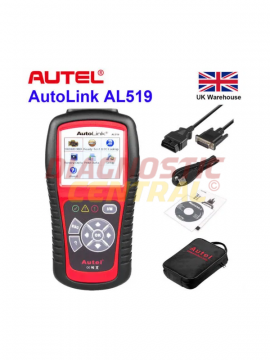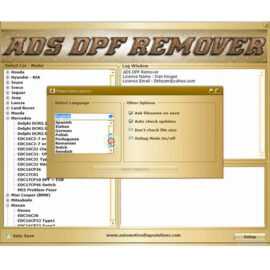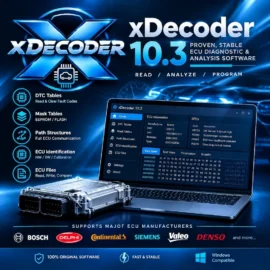
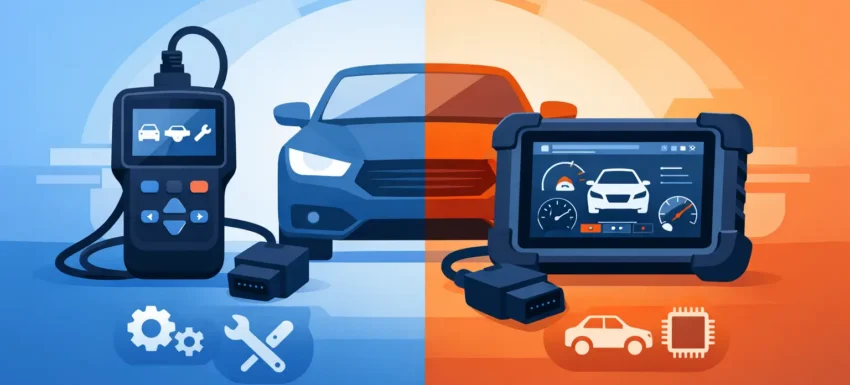
A vehicle arrives with an engine warning light, intermittent non-start and a list of communication faults. This is where the difference between generic versus manufacturer scan tools stops being a catalogue question and becomes a workshop decision. Both can read faults. Only one may give you the access, test functions and guided information needed to repair the vehicle properly on the first visit.
A generic scanner is often the right place to start, particularly for multi-make work and competent DIY diagnosis. A manufacturer-level tool earns its place when you need deeper access to a particular vehicle group, module coding or model-specific repair procedures. The better choice depends on what you work on, what functions you sell and how costly a missed diagnosis would be.
Generic versus manufacturer scan tools: the real difference
Generic scan tools communicate through standardised diagnostic protocols, most commonly the OBD2 system fitted to petrol cars sold in the UK from 2001 and diesel cars from 2004. At their most basic, they retrieve and clear powertrain fault codes, display live engine data and show readiness-monitor status.
That baseline capability is useful. A good generic multi-make unit can identify an air flow reading that makes no sense, confirm whether coolant temperature is believable, check fuel trims and show why an engine management light has appeared. Better professional multi-make tools go considerably further, offering access to body, ABS, airbag, transmission and service systems across a wide range of makes.
Manufacturer scan tools, sometimes called dealer-level or brand-specific tools, are designed around one manufacturer or vehicle group. Their strength is not simply reading more codes. They understand the language of that vehicle. That can mean full module identification, manufacturer fault descriptions, guided tests, calibrations, adaptations, coding and configuration options that a generic tool may not support.
The distinction is not absolute. There are strong multi-make platforms with extensive service and coding functions, while some low-cost brand-specific devices offer little more than enhanced code reading. Capability is determined by the exact tool, software coverage and vehicle, not the label on the box.
What a generic tool does well
For a workshop that sees a broad mix of cars and light commercial vehicles, a quality generic scanner is usually the most productive first purchase. It avoids the cost and clutter of carrying separate equipment for every badge that enters the bay.
Its biggest advantage is speed. Plug in, identify the vehicle, run a full system scan and get a clear starting point. This suits routine warning-light work, servicing, pre-MOT checks and initial assessments. A mobile technician can often establish whether a fault sits in the engine, ABS, airbag or charging system before committing to further testing.
Generic tools also make sense for owners who want reliable information rather than guesswork. Reading the fault code before replacing parts can prevent a great deal of wasted spend. A code for an oxygen sensor circuit, for example, does not automatically condemn the sensor. It could point to damaged wiring, a connector issue, an exhaust leak or a mixture fault. Live data helps separate these possibilities.
The most useful generic units include practical maintenance functions. Depending on coverage, these may handle oil service resets, electronic parking brake service mode, battery registration, steering-angle sensor calibration, injector coding, diesel particulate filter functions and brake bleed routines. For many independent garages, this covers the work that pays the bills day after day.
Where generic coverage can run out
The weak point appears when a vehicle needs more than a scan and a reset. Modern cars contain multiple control modules, often communicating over several networks. A generic tool may identify a fault but offer limited detail, omit a module entirely or be unable to run the required actuator test.
Take a late-model vehicle with an intermittent parking sensor fault. A generic device may report a communication code in the parking-assist module. A manufacturer-level platform may show which sensor is dropping out, display its measured value, run an individual test and provide a wiring reference or guided diagnostic path. That is the difference between a targeted repair and removing bumpers on speculation.
Coding and configuration are another dividing line. Replacing a module is no longer always a matter of fitting the part and clearing codes. The replacement may require vehicle-specific configuration, component protection procedures, online access, security authorisation or software programming. A generic scanner can be excellent for confirmation and routine service work, yet still be the wrong tool for commissioning that module.
There is also a coverage issue with newer systems. Advanced driver-assistance systems, high-voltage vehicle controls, gateway security and manufacturer-specific network designs can restrict access. Tool makers update software regularly, but no multi-make platform can promise identical depth on every make, model and production year.
Fault codes are a starting point, not a diagnosis
Whether the tool is generic or manufacturer-level, fault codes do not replace technical testing. A stored code tells you what the control unit has detected, not necessarily which component has failed.
Use freeze-frame data, live readings, wiring checks and basic mechanical inspection alongside the scan result. A battery tester and charging-system test are particularly valuable when multiple unrelated faults appear. Low voltage can create a convincing collection of module and communication errors that disappear once the underlying battery or alternator problem is corrected.
When manufacturer-level diagnostics pay for themselves
Brand-specific capability becomes commercially sensible when your vehicle mix is predictable. A Volkswagen Group specialist, BMW independent or garage handling a regular stream of Ford vans will gain more from deep access to those vehicles than from broad but shallow coverage across every badge.
It is especially valuable where your work includes control-unit replacement, keys and immobiliser-related tasks, coding, retrofits, electronic parking brakes, transmission adaptations or complex electrical fault-finding. Time spent searching for unavailable functions is time lost. So is the risk of sending a vehicle elsewhere after completing half the job.
Manufacturer tools can also provide clearer information. Instead of a generic description such as ‘manufacturer-controlled auxiliary output’, you may see the exact subsystem, operating conditions and associated measured values. That clarity improves repair confidence, helps technicians document their findings and makes customer conversations more straightforward.
However, deeper access brings greater responsibility. Incorrect coding, programming or adaptation settings can immobilise a vehicle or create new faults. Some procedures need a stable power supply, correct software version and an understanding of the system being changed. Access is valuable only when the operator has the knowledge to use it safely.
Cost, updates and workshop reality
The purchase price is only part of the equation. Generic scanners are often more affordable upfront and may offer wide vehicle coverage under a single update plan. That makes them attractive for general repairers, mobile technicians and home users.
Manufacturer-level systems can involve subscriptions, licences, security access, approved interfaces or paid software functions. Some aftermarket tools offer brand-focused coverage without the full dealer-tool cost, but buyers should check exactly what is included. ‘Supports coding’ is not enough. Ask which modules, which model years, whether the function is online or offline, and whether UK vehicles are covered.
Update support matters just as much as headline functions. Vehicle electronics change quickly, and a tool that was excellent three years ago may struggle with current gateway systems or newly released models. Choose equipment from a supplier that states its coverage clearly and can help you match the tool to the work you actually undertake.
For a busy independent garage, the most effective arrangement is often not generic or manufacturer-specific. It is a dependable multi-make scanner for first-line diagnosis and routine service work, backed by specialist capability for the marques you see most often. This gives the workshop breadth without sacrificing depth where it makes money.
How to choose the right scan tool
Start with the vehicles on your ramp, not the biggest function list. Review the last three months of work. If most jobs involve mixed makes, engine lights, servicing and basic system faults, invest first in a capable generic platform with strong live data and service coverage. If one or two vehicle groups repeatedly require coding, adaptations or deeper module work, add the relevant manufacturer-level option.
Before buying, check the exact models and years you need to support. Confirm whether the tool can read all installed systems, perform bi-directional tests, display live data in useful form and carry out the service functions you use. For professional use, assess update costs, cable and adaptor availability, screen usability, technical support and diagnostic report functions as well.
Diagnostic Central’s range is built around this practical approach: equipment should reduce uncertainty, not add another layer of it. The right tool gives you usable evidence quickly, then leaves the technician free to make the repair decision.
Buy for the job in front of you and the work you intend to win next. A scanner that accurately identifies the fault, supports the repair and keeps vehicles moving is worth far more than one with an impressive specification that never reaches the system you need.