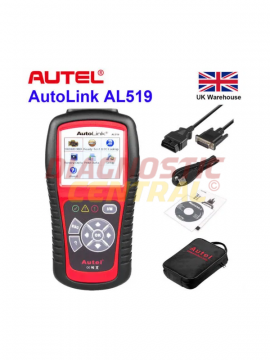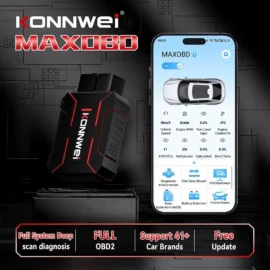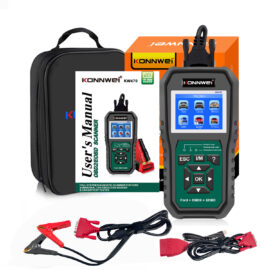
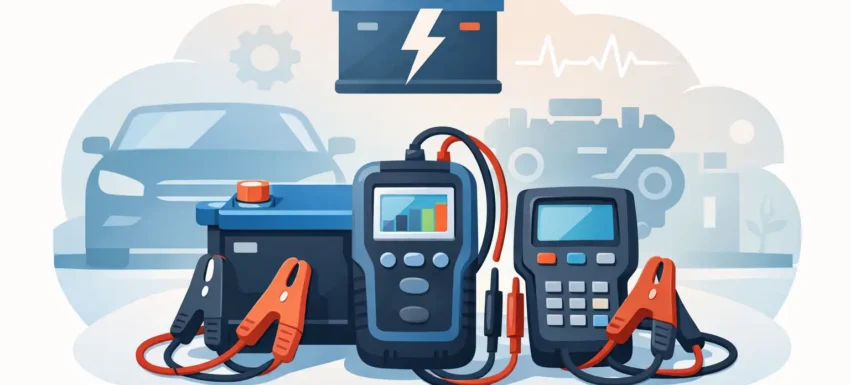
A battery can show 12.6V at rest and still fail the moment the starter demands serious current. That is why the question, “which battery tester do I need?”, is not answered by buying the cheapest device with a screen. The right tester must assess battery condition under the circumstances you actually see in the workshop, on a driveway or at the roadside.
For most vehicle work, a proper automotive battery tester is faster and more useful than a multimeter alone. It can estimate available cranking performance, identify a weak or sulphated battery, and often check the charging and starting systems too. But there are meaningful differences between conductance testers, traditional load testers and basic voltage checkers. Buy for the batteries and vehicles you work on, not simply for the longest feature list.
Which battery tester do I need for routine diagnostics?
A digital conductance battery tester is the best all-round choice for most garages, mobile mechanics and capable DIY motorists. It applies a small AC signal through the battery, measures internal resistance and conductance, then compares the result with the battery’s stated rating. Rather than just reporting voltage, it gives a practical assessment such as good battery, recharge and retest, or replace.
This matters because voltage only tells part of the story. A fully charged but worn battery may look healthy on a meter, yet have too little cranking capacity to start a cold diesel engine. Conductance testing is quick, does not heavily discharge the battery and can usually be carried out with the battery fitted to the vehicle. That makes it the sensible default for busy diagnostic work.
Choose a unit that supports the battery ratings you encounter. In the UK, EN is common on European vehicle batteries, while SAE, DIN, IEC and JIS are also regularly seen. A tester that cannot accept the rating printed on the battery label is more likely to give an unhelpful result. For regular passenger-car work, a 12V tester with a broad CCA range and support for EN, SAE, DIN, IEC and JIS covers the majority of jobs.
If you want to diagnose a no-start complaint properly, look for charging and cranking tests as well. A cranking test records voltage drop while the engine is started. A charging test checks alternator output and can highlight overcharging, undercharging or excessive ripple. These functions prevent a common and costly mistake: replacing a battery when the real fault is a poor earth connection, starter motor issue or charging-system defect.
When a load tester is the better tool
A traditional carbon-pile or fixed-load battery tester puts a genuine heavy load onto the battery for a short period. It is a direct way to see whether battery voltage collapses under demand, and it remains useful in workshops dealing with conventional lead-acid batteries, older vehicles and high-capacity commercial applications.
The trade-off is speed and practicality. Load testing generates heat, draws substantial current and requires more care than conductance testing. The battery should be sufficiently charged before testing, and repeated tests can further discharge an already weak unit. For a mobile technician or a garage processing several vehicles each day, it is rarely the most convenient first-line tool.
A load tester is worth considering as a second tester where you need to verify suspect batteries under a controlled load, especially on older stock or larger batteries. It is not automatically more accurate in every situation. A quality conductance tester is usually the more efficient choice for modern vehicle diagnostics, provided its test range and battery-type support are correct.
Match the tester to battery technology
Modern batteries are not all standard flooded lead-acid units. Start-stop vehicles commonly use AGM or EFB batteries, and testing them as a basic flooded battery can lead to the wrong decision. Select a tester that explicitly supports flooded, AGM flat plate, AGM spiral, EFB and gel batteries if those types are part of your normal workload.
AGM batteries, in particular, need the correct test mode and rating entered from the label. They are designed for repeated cycling and high electrical demand, but they can still suffer from chronic undercharging, parasitic drain and age-related loss of capacity. A tester that identifies battery health alongside state of charge gives you a stronger basis for advising whether to recharge, investigate the vehicle or replace the battery.
Lithium starter batteries are less common on everyday vehicles but appear in specialist, performance and motorcycle applications. Do not assume a lead-acid tester is suitable. If lithium testing matters to your work, buy a model specifically designed for the lithium chemistry involved. Using the wrong test method can produce misleading readings and may not be safe.
Check voltage range before buying
A 12V tester is enough for cars, vans, motorcycles and many leisure applications. It will not cover every job in a commercial workshop. Lorries, plant machinery, agricultural equipment and some fleet vehicles use 24V systems, typically formed from two 12V batteries. In these cases, you need a tester capable of checking both individual 12V batteries and the complete 24V system.
Testing each battery separately is essential on a twin-battery arrangement. One weak battery can drag down the whole system, while a test across both may only confirm that the combined voltage is low. A tester with 6V, 12V and 24V capability is more versatile for workshops serving mixed vehicle fleets, but there is little value in paying for 24V coverage if you work solely on private cars.
Also consider the CCA range. A small motorcycle battery and a large diesel van battery sit at very different ends of the scale. Your tester should cover the lowest and highest ratings you are likely to see, without forcing you to guess. Always enter the rating printed on the battery case, and choose the matching standard on the tester menu.
The features that make daily testing quicker
The most useful feature is not necessarily a large colour display. It is a clear result that allows you to act. For professional use, look for an easy-to-read verdict, state-of-health and state-of-charge values, measured CCA, internal resistance and a simple charging or replacement recommendation.
A built-in printer or report function can be worthwhile for a garage. A battery test printout gives the customer evidence, supports an advised replacement and records the battery condition at the time of inspection. For mobile technicians, a compact tester with long leads, solid clamps and a durable case often matters more than printed paperwork.
Build quality should not be treated as an optional extra. Battery terminals are dirty, access can be awkward and workshop equipment gets dropped. Choose well-insulated leads, strong clamps and controls that can be operated without a lengthy setup. A tester that produces a result in seconds is only useful if its connections remain reliable after repeated use.
Do not confuse a battery tester with a charger
A tester diagnoses condition; it does not restore a discharged battery. If the result says recharge and retest, use a suitable smart charger before condemning the battery. This is especially relevant when a vehicle has been standing, has made repeated short trips or has recently had a parasitic drain issue.
After charging, test again and investigate why the battery became discharged. A healthy battery that is repeatedly flat points towards the vehicle, not the battery itself. Check alternator performance, battery connections, earth straps and key-off current draw before fitting parts. Good diagnostics means finding the cause, not simply reacting to the symptom.
A practical buying decision
For most motorists, a compact 12V conductance tester that supports flooded, AGM and EFB batteries, plus EN and SAE ratings, is the right starting point. It gives a far more dependable answer than voltage alone and helps distinguish a flat battery from a failed one.
For independent garages and mobile technicians, choose a professional conductance tester with cranking and charging tests, wide rating coverage and clear report-style results. If you regularly handle lorries, plant or fleet vehicles, add 24V capability and ensure it can test individual batteries in a multi-battery system. A conventional load tester is valuable where heavy-load verification is part of your process, but it should complement rather than replace modern electronic testing.
The best battery tester is the one that matches the battery technology, voltage and working environment in front of you. Start with the vehicles you diagnose most often, then buy enough capability to deal with the jobs you want to take on next. That approach keeps battery testing quick, accurate and profitable rather than another source of workshop guesswork.