
A vehicle that starts perfectly on Monday but barely turns over on Thursday has an electrical fault until proven otherwise. If you are asking, why is my battery draining, do not assume the battery is simply old or that a longer drive will fix it. A flat battery is a symptom. The real cause may be a weak battery, poor charging, an excessive key-off drain, or a connection problem that only shows itself under load.
The quickest route to a proper repair is to test the system in the right order. Replacing parts before measuring voltage, charging performance and current draw wastes time and often leaves the original fault in place.
Why is my battery draining when the car is parked?
When the ignition is off, a modern vehicle is never completely dead. The alarm, central locking receiver, clock, ECU memory and telematics systems all need a small standby current. That is normal. The problem starts when a control unit fails to enter sleep mode, an accessory remains live, or a battery no longer has enough usable capacity to support normal standby demand.
Short journeys are another common factor. Starting an engine takes a significant amount of energy from the battery. If the vehicle then covers a few miles in traffic, with heated screens, blower motor, lights and infotainment running, the alternator may not replace what was used. This is especially common in winter and in stop-start vehicles, where battery condition has to be better than merely “good enough”.
A battery that goes flat overnight points more strongly towards a parasitic draw, an interior or boot light staying on, an aftermarket dash camera, tracker, amplifier or faulty module. A battery that gradually becomes weak over several days may be undercharged, ageing, or being used on repeated short runs.
Start with battery condition, not guesswork
Before testing for a drain, charge the battery fully with a suitable smart charger. Testing a partially charged battery can produce misleading results. A low state of charge may look like a failed battery, while an actually weak battery may appear acceptable immediately after the engine has been running.
After charging and allowing the battery to rest, check its open-circuit voltage. Around 12.6V usually indicates a fully charged conventional lead-acid battery, while around 12.2V suggests it is substantially discharged. Voltage alone is not a health test, though. A battery can show respectable voltage with no load and collapse as soon as the starter motor demands current.
A proper battery tester is more useful because it assesses conductance, available cranking performance and state of health. It also helps distinguish between a battery that needs charging and one that has lost capacity due to sulphation, age or internal damage. For workshops, this is a faster and more defensible starting point than replacing a battery on appearance alone.
Check the terminals at the same time. Loose clamps, corrosion around the posts, damaged earth straps and high-resistance connections can prevent the battery charging properly or restrict starter current. A terminal that looks clean can still be loose enough to cause intermittent no-start faults. Inspect the battery earth to body and engine earth strap, particularly on older vehicles exposed to water and road salt.
Check whether the alternator is charging correctly
A healthy battery cannot stay healthy if the charging system is weak. With the engine running, a conventional alternator commonly produces roughly 13.8V to 14.7V at the battery, depending on temperature and electrical load. Switch on headlights, heated rear window and blower motor, then check that charging voltage remains sensible and stable.
Modern smart charging systems need more careful interpretation. On many newer cars, the ECU deliberately varies alternator output to reduce engine load and improve emissions figures. You may see battery voltage move between low charging voltage and around 15V, depending on battery state, deceleration, load and battery sensor data. Do not condemn an alternator purely because it is not holding a fixed 14.4V.
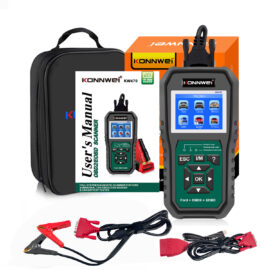
Instead, use live data where available and check for charging-system fault codes, battery monitoring sensor faults and voltage drops across the main positive and earth cables. An OBD diagnostic tool can be particularly useful on vehicles with intelligent battery sensors, where the fault may sit in battery management rather than the alternator itself.
If a stop-start vehicle has had a battery replaced, confirm that the correct type has been fitted. AGM and EFB batteries are not interchangeable in every application. Some makes also require battery registration or coding so the energy management system understands the battery’s age, capacity and technology. Skipping this step can shorten battery life and create stop-start or charging complaints.
Find a parasitic draw with a current test
If the battery and charging system test correctly, measure key-off current draw. This identifies whether the vehicle is consuming more power than it should while parked.
The test must be done properly. Lock the vehicle or latch the door catches as required, keep the key away from the car, and allow every module time to enter sleep mode. Depending on the vehicle, this can take 20 minutes or considerably longer. Opening a door, waking the infotainment system or connecting equipment incorrectly can reset the process and give a false high reading.
As a broad guide, many vehicles settle below 50mA once asleep, although acceptable figures vary by make, age and fitted equipment. A high-specification vehicle with telematics may draw more briefly before sleeping. What matters is whether the current reduces as modules time out, and whether it remains high enough to flatten the battery over the period reported by the customer.
Use a DC clamp meter where possible. It avoids disconnecting the battery, which can wake modules, lose memory settings and interrupt the test. A multimeter connected in series can work, but it must be rated correctly, connected safely and protected from starter current. Never attempt to crank the engine with a meter in the current circuit.
If the draw remains excessive, remove fuses one at a time while monitoring current. When the reading drops, you have narrowed the fault to a circuit. From there, identify every item supplied by that fuse rather than assuming the first component you see is at fault. A boot latch switch, glovebox lamp, door control unit, radio, aftermarket accessory or water-damaged wiring may all share the same circuit.
Common causes that are easy to miss
Some battery drains are obvious only after the vehicle has been inspected in the dark. A boot lamp that remains on, a vanity mirror light, a glovebox switch or a trailer socket fault can drain a battery without attracting attention. Look for warm modules, illuminated switches and interior lamps that do not extinguish.
Aftermarket equipment deserves close scrutiny. Dash cameras hard-wired without a reliable low-voltage cut-off, poorly installed amplifiers, trackers, phone chargers and auxiliary lighting are regular causes of unwanted current draw. Disconnecting them temporarily is a practical diagnostic step, but do not stop there if the draw remains. More than one fault can exist.
Water ingress is another workshop regular. Damp carpets, wet fuse boxes, corroded connectors and condensation in tailgates can keep circuits active or create resistance that confuses control modules. Scan every relevant module for fault codes before stripping parts out. Communication faults, low-voltage history codes and repeated wake-up events can point directly towards the affected area.
When the battery itself is the problem
Most 12V batteries last several years, but service life varies sharply with usage, climate, charging pattern and vehicle type. Repeated deep discharge is particularly damaging. Once a lead-acid battery has been flattened several times, sulphation can reduce its usable capacity even after it has been recharged.
That means a battery can pass a basic voltage check but still be unsuitable for a vehicle with stop-start, lots of short trips or high electrical demand. Test it against its rated cold cranking amps and replace it with the specified technology and capacity if it fails. Fitting a cheaper conventional battery where AGM is required is a false economy.
A practical diagnostic order that saves time
For a recurring flat battery, follow a disciplined sequence: fully charge and test the battery, inspect terminals and earths, verify charging-system operation, scan for related faults, then carry out a sleep-mode current draw test. This order prevents a parasitic draw investigation on a battery that is simply worn out, while also preventing an unnecessary battery sale when the alternator or an accessory is at fault.
Diagnostic Central supplies the battery testers, OBD diagnostic equipment and workshop accessories needed to turn this from a guess into a measured repair. Whether you are checking one family car or processing daily bookings in a busy garage, accurate readings give you a clear basis for the next decision.
Do not keep jump-starting a vehicle and hoping the fault disappears. Record the battery test result, charging voltage and settled current draw, then repair what the figures show. A battery that stays charged after that is not luck – it is proof that the real fault has been found.