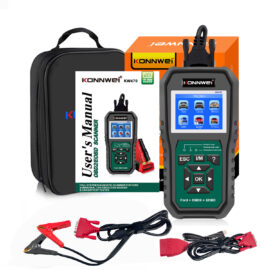
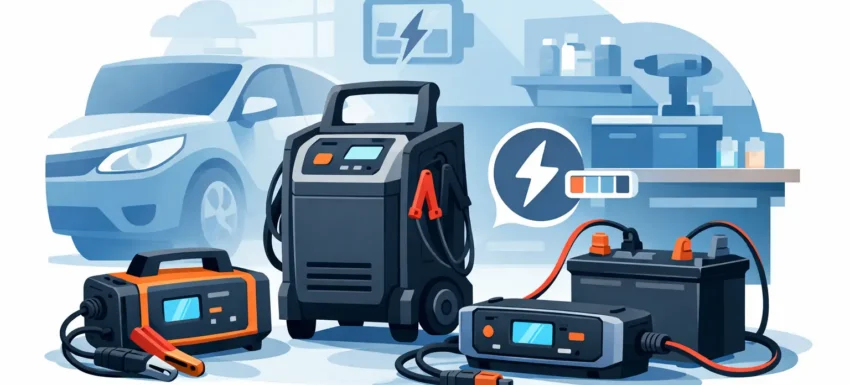
A vehicle arrives with a no-start complaint, but the fault code reader will not help if system voltage has collapsed before testing begins. The best battery chargers for garages are not simply the ones with the biggest amp rating. They are the units that recover batteries safely, support modern electrical systems, and keep a workshop moving without tying up a ramp or wasting a technician’s time.
For a home user, a compact smart charger may be all that is needed to look after a weekend car. For an independent garage dealing with stop-start vehicles, diesel vans and customer cars sitting with doors open during diagnosis, charging equipment needs to do more. It must recognise battery condition, deliver a stable output and cope with repeated daily use.
What a garage battery charger must do
A charger should earn its space on the wall or trolley. At minimum, it needs to charge the battery chemistry fitted to the vehicle and offer protection against reverse polarity, short circuits and overheating. That is the baseline, not a premium feature.
The real difference comes with intelligent charging control. A proper multi-stage charger assesses voltage, applies the appropriate bulk charge, reduces current as the battery fills, and switches to maintenance when required. This reduces the risk of overcharging and makes the unit far more useful on vehicles left in the workshop overnight.
For professional work, look for a power supply or support mode as well. Modern cars can draw substantial current when diagnostic equipment is connected, ignition is on, cooling fans cycle or modules remain awake. Voltage dropping during a software update, coding procedure or lengthy scan can create avoidable faults. A charger capable of stable support voltage is a workshop safeguard, not a luxury accessory.
Best battery chargers for garages: choose by job
There is no single charger that suits every bay. The right purchase depends on the vehicles passing through the door and whether the charger is intended for recovery, maintenance or stable power support.
Smart maintainers for low-use and stored vehicles
A 4A to 8A smart maintainer suits motorcycles, classic cars, seasonal vehicles and cars that are not driven regularly. It is compact, straightforward and ideal for preventing a healthy battery from becoming flat while a vehicle is parked.
It is not the first choice for turning around a heavily discharged 95Ah diesel battery. A small charger may eventually do the job, but it will take time, and a battery that has been deeply discharged may need testing before it is trusted. For a DIY owner, this type of unit is excellent value. For a busy garage, it works best as a supplementary tool.
Mid-output chargers for everyday car and van work
A 10A to 25A automatic charger is the practical middle ground for many independent workshops. It will recharge typical passenger vehicle batteries in a sensible time, manage maintenance charging, and often include programmes for AGM, EFB and conventional lead-acid batteries.
This is the category that makes sense for garages handling routine servicing, MOT preparation, battery replacement and no-start investigations. It should have leads that are long enough to reach a battery positioned in a boot or under a seat, with clamps that grip securely rather than slipping off corroded terminals.
An AGM setting matters. Absorbent Glass Mat batteries are common in stop-start vehicles, and using an old basic charger with no chemistry selection can leave the battery undercharged or, in the wrong circumstances, stressed by an unsuitable charging profile. EFB batteries also benefit from a charger designed for modern start-stop applications.
High-output workshop chargers for rapid recovery
Chargers rated at 30A, 50A or more are intended for garages where battery recovery is a regular job. They reduce waiting time on larger batteries fitted to diesels, vans and light commercial vehicles. They are also more capable when several electrical loads are active during fault-finding.
Higher output does not mean a charger should be left unattended on every battery. A severely sulphated or internally damaged battery will not be repaired by forcing more current into it. If a battery becomes hot, gives off a strong sulphur smell, will not hold voltage after charging, or fails a conductance test, replacement is usually the correct repair.
For fleets and commercial work, choose a unit with a clear operating display, a durable case and a charging lead designed for workshop treatment. Cheap clamps, short cables and vague status lights become a daily irritation when the charger is used dozens of times each week.
Power supply units for diagnostics, coding and programming
A battery charger and a diagnostic power supply are related, but not identical. A charger focuses on putting energy back into the battery. A support unit is designed to hold a controlled voltage while the vehicle is consuming current.
This distinction matters when carrying out module coding, service resets requiring the ignition on, advanced scans, or software programming. A nominal 13.5V to 14.4V support output, with sufficient current capacity for the vehicle concerned, helps prevent low-voltage interruptions. For ordinary code reading, a small maintainer may be adequate. For programming work on modern vehicles, use a purpose-built stabilised support unit with the required amp capacity.
Match the charger to battery technology
Most garage chargers will spend their life connected to 12V lead-acid batteries, but lead-acid is not one uniform category. Flooded batteries, calcium batteries, EFB and AGM types respond best to different charge profiles. Check the vehicle battery label rather than assuming that every black case under a bonnet is the same.
Lithium 12V starter batteries need particular care. They require a charger with a dedicated lithium mode and compatible safety controls. Never select a lithium programme for a lead-acid battery, or vice versa. The wrong mode can damage the battery or create a safety risk.
Voltage matters too. A 12V charger cannot service a 24V lorry system, and using two 12V batteries in series does not remove the need for suitable 24V equipment. Workshops dealing with commercial vehicles should buy a charger that explicitly supports 24V operation, with output capacity appropriate for larger battery banks.
Features worth paying for
Do not judge charging equipment on amp rating alone. A clear display showing battery voltage, selected mode and charging progress makes diagnosis quicker. Temperature compensation is useful in cold workshops, because charging characteristics change with temperature. A reconditioning or desulphation mode can sometimes recover a mildly neglected lead-acid battery, although it should not be treated as a cure for physical battery failure.
Memory saver capability can be useful during battery replacement, but it needs careful use. It is intended to preserve settings and learned values, not to bypass safe replacement procedures. Confirm correct connections before disconnecting a battery, and be especially cautious on vehicles with battery monitoring sensors, security systems or complex electronic modules.
Portability is another genuine consideration. A wall-mounted charger is always where it should be, while a wheeled high-output unit can be moved between bays. Mobile technicians may value a compact model with a tough case and reliable mains lead more than a heavy workshop trolley. The best choice fits the way the work is actually carried out.
Charge after testing, not instead of testing
A flat battery is a symptom until proven otherwise. Before fitting a charger, inspect terminals, earth straps and cables for looseness, corrosion or heat damage. Check the battery’s resting voltage, then test its cranking performance and charging system output once the engine is running.
A battery that repeatedly goes flat may have a parasitic drain, an alternator fault, a failing battery sensor or a battery that has lost usable capacity. Charging it returns the vehicle to service temporarily, but it does not identify the cause. This is where a battery tester and diagnostic scanner work alongside the charger: one assesses battery health, while the other can help reveal charging-system or network faults.
At Diagnostic Central, the practical approach is simple: establish battery condition first, provide stable power where diagnostics demand it, and replace components only when the test results justify it. That protects the customer from guesswork and protects the workshop from repeat work.
Use chargers safely in the workshop
Charge batteries in a well-ventilated area and follow the charger’s connection sequence. Switch the unit off before attaching or removing clamps where the manufacturer instructs it. Keep sparks, welding activity and naked flames away from batteries, particularly conventional flooded types that may release gas while charging.
Do not charge a visibly damaged, leaking, frozen or swollen battery. Check that the charger leads are intact and that clamps make clean contact with the correct terminals. On vehicles with remote charging points, use the designated positive terminal and earth point specified by the manufacturer rather than improvising around inaccessible batteries.
A quality charger pays for itself through fewer delayed repairs, stronger battery test results and more stable diagnostic sessions. Buy capacity for the vehicles you genuinely see, choose chemistry support for modern batteries, and treat every flat battery as the start of an investigation rather than the end of one.