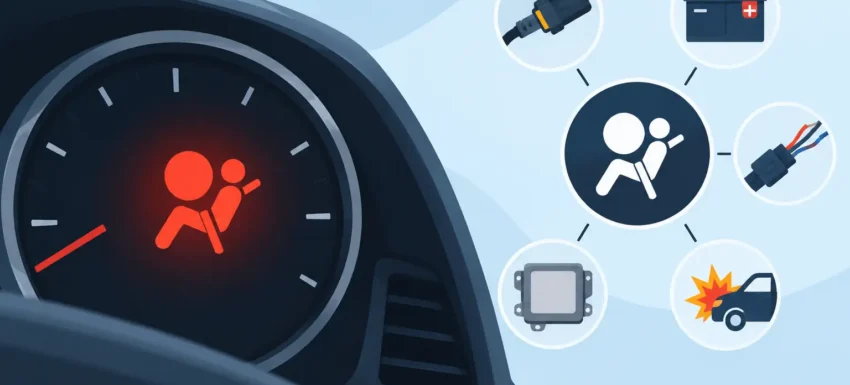
An illuminated airbag warning lamp is not a reminder to deal with later. It means the vehicle’s Supplemental Restraint System (SRS) has logged a fault and may not deploy, or may not deploy as designed, in a collision. The most common airbag light causes are not always the airbag itself. A loose seat connector, failed seat occupancy sensor or low-voltage event can be enough to bring the light on.
Quick answer
- The SRS light usually indicates a stored fault in an airbag, pretensioner, impact sensor, wiring circuit or control module.
- Generic engine-code readers often cannot access SRS data. You need a scanner with airbag-system coverage for the exact vehicle.
- Do not probe airbag or pretensioner circuits with a test lamp or standard multimeter.
- Clearing the warning without repairing the underlying fault rarely works for long and can leave a safety-critical system disabled.
Why the airbag light stays on
The airbag control module continuously monitors the resistance, voltage and communication status of the circuits it controls. This can include front, side, curtain and knee airbags, seat-belt pretensioners, passenger occupancy detection, crash sensors and steering-wheel wiring.
When a reading falls outside the permitted range, the module records a diagnostic trouble code and switches on the SRS warning lamp. The fault can be current, intermittent or historic, depending on the vehicle and the code. Some systems will extinguish the lamp after a successful repair and a number of drive cycles; many require the fault memory to be cleared with suitable diagnostic equipment.
For MOT purposes, an illuminated airbag warning lamp is normally a failure. More importantly, the system may be disabled or operating with reduced protection. Treat it as a safety repair, not simply a dashboard-light reset.
The most common airbag light causes
Under-seat wiring and connector faults
Movement of the front seats puts repeated strain on wiring beneath them. Connectors can loosen, terminals can develop poor contact and wiring can be trapped in seat runners. This is especially common where the seat has been moved frequently, damp carpets have caused corrosion, or accessories have been fitted around the seat base.
The resulting code may refer to a driver or passenger side-airbag circuit, seat-belt pretensioner or occupancy sensor. Do not assume the component named by the code has failed. A code for high resistance in a pretensioner circuit, for example, can be caused by the connector, wiring or module connector as well as the pretensioner itself.
Seat-belt pretensioner problems
Pretensioners tighten the belt rapidly during a significant impact. They are part of the SRS system and are monitored in the same way as airbags. Connector faults, damaged belt assemblies and deployed pretensioners can all trigger the warning lamp.
After a collision, any activated pretensioner must be handled in line with the manufacturer repair information. Fitting a used belt assembly may appear economical, but compatibility, deployment status and vehicle-specific part numbers all matter. Safety-system repairs are not the place for guesswork.
Steering-wheel clock spring failure
The clock spring, also called a spiral cable or rotary coupler, maintains electrical connection between the steering wheel and fixed steering column while the wheel turns. A broken internal ribbon can trigger an airbag fault, often alongside inoperative steering-wheel controls or horn issues.
This fault can follow normal wear, incorrect steering alignment after suspension work, or refitting a steering wheel with the clock spring off-centre. The diagnostic code and live data, where supported, help separate a clock-spring circuit issue from a driver-airbag module fault.
Passenger occupancy sensor faults
Many vehicles use a sensor or mat in the passenger seat to decide whether to enable the passenger airbag. A failed sensor can produce an SRS warning, an incorrect passenger-airbag status indication, or both.
These systems vary widely. Some use a pressure mat, some use seat-frame sensors and some rely on a dedicated occupancy module. An emulator may be advertised for certain vehicles, but it is not a universal repair and may be unsuitable for road use. Identify the exact system and follow the manufacturer’s repair procedure.
Impact sensors and module communication faults
Modern vehicles may have multiple accelerometers or satellite impact sensors located in the front structure, B-pillars, doors or rear body. Water ingress, accident damage, corrosion and wiring damage can interrupt communication with one of these units.
A fault code stating “no communication” does not automatically condemn the sensor. Check power supply, earth, network wiring and connector condition before replacement. On CAN-based systems, a wiring fault elsewhere on the network can occasionally create misleading communication faults.
Low battery voltage or charging-system issues
A weak battery, flat battery, jump-starting event or unstable charging voltage can create a low-voltage SRS code. This is common after a vehicle has been standing, particularly in winter. However, low voltage should not be treated as an automatic explanation for every airbag light.
Test the battery condition and charging system, repair any supply issue, then read and clear the codes correctly. If the same code returns immediately, the low-voltage event was likely not the sole cause. A battery tester is useful here because voltage alone does not show whether the battery can supply adequate current under load.
Previous accident damage and crash data
Following a collision, airbags and pretensioners may deploy, while the SRS module can store crash event data that prevents the system from being reset normally. Damaged sensors, wiring and connectors are also common around impact areas.
The correct repair can involve replacing deployed components, repairing the vehicle structure and wiring, and fitting or professionally resetting the control module where appropriate. Requirements differ by make, model and accident severity. Simply clearing codes will not remove hard crash data on many vehicles.
How to diagnose an SRS warning safely
Start by recording the complete vehicle identification and scanning the SRS module before touching anything. The exact code, status and freeze-frame data can save considerable time. A basic EOBD reader may read engine emissions faults only, so it may show no codes even with the airbag lamp illuminated.
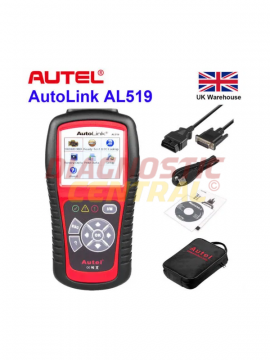
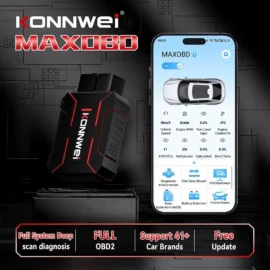
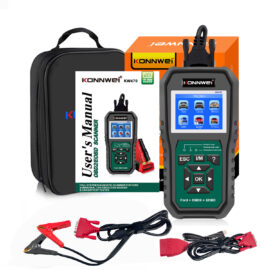
Use a diagnostic scanner that specifically supports SRS functions on the make and model concerned. For garages working across several brands, a multi-make diagnostic tool with enhanced airbag coverage can provide code reading, clearing and live data where supported. For a single vehicle, confirm exact model-year, system coverage and required functions before buying equipment.
Next, inspect obvious areas indicated by the code: under-seat looms, connectors, seat-belt wiring, steering-column components and areas affected by water or collision damage. Look for trapped wires, poor repairs, corrosion and non-standard connectors. Do not disconnect or measure SRS components until the manufacturer’s depowering procedure has been followed. This commonly involves disconnecting the battery and waiting for the specified period so the system’s reserve energy can discharge, but the exact procedure matters.
Avoid using test lamps, continuity buzzers or ordinary resistance testing directly across airbag and pretensioner connectors. Incorrect testing can trigger deployment or damage the control module. Professional fault-finding may use approved breakout leads, simulator loads and manufacturer test routines, but only where the technician understands the system and follows the relevant safety information.
Once the physical repair is complete, clear the fault memory and recheck the module. If the code returns straight away, the circuit remains faulty or the repair is not accepted by the module. If it returns only after seat movement or during a road test, an intermittent harness issue becomes more likely.
Why clearing the code is not the repair
Code clearing has a valid role after a fault has been repaired or after a confirmed one-off voltage event. It is not a fix for an active SRS defect. Repeated clearing can hide a pattern, waste workshop time and leave the driver with false confidence.
This is where clear diagnostic data pays for itself. A code gives a starting point, while circuit status, live values and a careful inspection determine whether the cause is a connector, loom, sensor, restraint component or module. Diagnostic Central’s experienced mechanics recommend recording codes before replacement work, especially on vehicles with previous accident repairs or several stored SRS faults.
Airbag light FAQs
Can I drive with the airbag light on?
The vehicle may still drive normally, but its restraint system may not operate correctly in a crash. Arrange diagnosis as soon as possible and do not treat the warning as cosmetic.
Will disconnecting the battery reset the airbag light?
Usually not. It may erase temporary settings on some vehicles, but SRS fault codes are generally retained in the control module. The original fault can also remain active.
Can an OBD2 scanner read airbag codes?
Some can, but many low-cost readers only access engine-related EOBD codes. Check that the tool supports SRS diagnostics for your exact make, model and year.
Why did the light appear after moving the seat?
Seat movement can disturb wiring or connectors beneath the seat, particularly those for side airbags, pretensioners and occupancy sensors. The stored code should guide the inspection.
Before ordering a scanner or replacement part, contact Diagnostic Central with the registration, VIN and the SRS functions you need. Matching the equipment to the vehicle is the fastest way to move from a warning lamp to a properly evidenced repair.