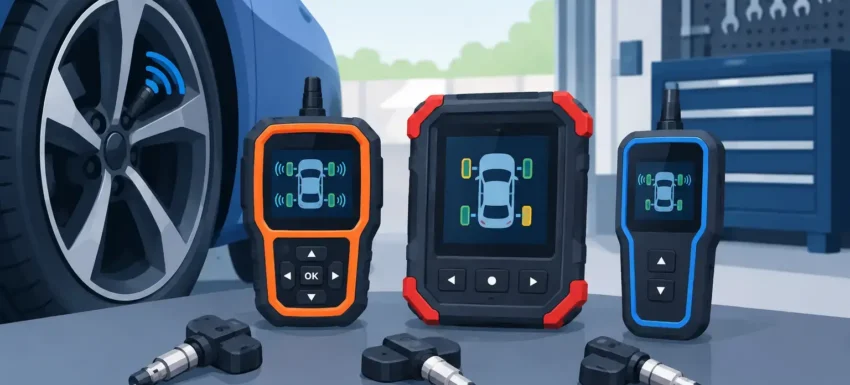
A tyre pressure warning light after fitting tyres, replacing a valve sensor or rotating wheels is rarely fixed by simply clearing a fault code. The right tool must communicate with the sensor at the wheel, identify what the vehicle expects to see and, where supported, complete the correct relearn. This TPMS scanner comparison separates basic sensor readers from workshop-grade programming tools, so you can buy for the work in front of you rather than for a long list of functions you will never use.
Quick answer
- A trigger-only TPMS tool confirms whether a direct sensor is transmitting, but it will not necessarily reset the warning light or programme a replacement sensor.
- A tool with OBD relearn capability is the practical minimum for garages regularly fitting tyres or replacing sensors on modern vehicles.
- Universal-sensor programming is valuable when you stock compatible programmable sensors, but it is not a substitute for checking vehicle coverage and sensor protocol.
- A full diagnostic scanner can access TPMS fault codes on many vehicles, yet may not activate wheel sensors or write their IDs after replacement.
Start with the job, not the specification sheet
TPMS tools are often compared by the number of makes listed on the box. That is useful, but it does not tell you whether the tool can perform the one procedure needed on the vehicle in the bay. A Ford that requires sensor IDs written through the diagnostic socket, for example, needs a different level of capability from a vehicle that learns its sensors automatically after a road procedure.
Direct TPMS uses a battery-powered sensor inside each wheel, normally incorporated into the valve assembly. It transmits pressure, temperature and identification data by radio frequency. The workshop tool wakes or triggers the sensor and displays its data. Indirect TPMS, by contrast, uses ABS wheel-speed information to infer a pressure loss. There are no valve sensors to trigger or programme, so a conventional TPMS sensor scanner has limited value for that system.
For UK workshops, this distinction matters. A TPMS malfunction warning on applicable vehicles can be an MOT issue, but replacing parts without proving the fault wastes time. First establish whether the vehicle has direct or indirect monitoring, then check the exact make, model, year and system fitted.
TPMS scanner comparison: the four tool levels
1. Basic sensor activation and reading tools
An entry-level TPMS scanner activates compatible direct sensors and shows live information such as sensor ID, pressure, temperature, battery status and frequency. It is a useful diagnostic starting point when a warning light is on, especially after wheel damage, corrosion around a valve, or an unexplained loss of communication.
This type suits competent DIY users and technicians who want to prove whether each sensor is alive before removing tyres. It can quickly identify the common situation where three sensors respond and one does not. However, it is usually a read-only solution. It may not relearn sensor positions, register a new ID through the OBD port or programme a blank universal sensor.
Choose this level if diagnosis is the priority and sensor replacement work is occasional. It is not the right choice for a tyre bay that needs to complete the repair from start to finish.
2. TPMS tools with relearn functions
The next step combines sensor activation with vehicle relearn procedures. Depending on vehicle support, this may guide the operator through an automatic, stationary or OBD-based relearn. A stationary relearn typically has you trigger each wheel in a prescribed order while the car is in learning mode. An OBD relearn writes the sensor IDs directly into the TPMS control unit.
This is often the best balance for independent garages. It handles the tasks that cause the most delays after tyre work: confirming each sensor responds, locating wheel positions and registering correct IDs after a replacement. Good guided instructions reduce errors, but they do not remove the need to follow the vehicle procedure accurately. Ignition position, wheel order, tyre pressures and module communication can all affect the result.
Check whether OBD relearn is included for the vehicles you see most often. Some tools offer broad activation coverage but more limited OBD functions, particularly on newer models or less common marques.
3. Universal sensor programming tools
A programming-capable TPMS tool can configure supported universal sensors either by cloning the old sensor ID or by creating a new ID for relearn. Cloning is efficient when the original sensor still communicates: programme the new sensor with the same ID, fit it and the vehicle may recognise it without a separate relearn. That outcome depends on the vehicle and system, so it should never be assumed.
Creating a new ID is necessary where the original sensor has failed completely or is unavailable. The scanner then programmes the new sensor and carries out the appropriate vehicle relearn. This approach gives a workshop flexibility over sensor stock, but it also introduces an important compatibility check. The replacement sensor must be supported by the programming tool and suitable for the vehicle’s frequency, protocol and valve arrangement.
For tyre specialists, mobile tyre fitters and busy multi-brand garages, this category can save stock space and reduce waiting for vehicle-specific sensors. The trade-off is that technicians need a clear process for checking sensor compatibility before fitting. A wrongly programmed sensor means removing the tyre again.
4. Full diagnostic scanners with TPMS coverage
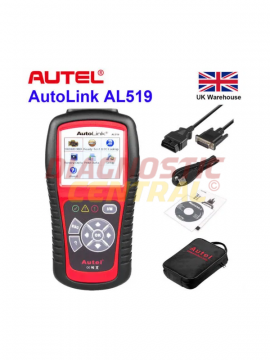
Many multi-system diagnostic scanners read TPMS control-unit codes, live data and warning-light status. That makes them valuable when the sensor itself is not the whole story. A module communication fault, wiring issue, receiver problem or configuration error may require diagnostic access beyond a handheld sensor trigger tool.
The limitation is that TPMS menus vary widely. A general scan tool may read faults and command a relearn on supported vehicles, but lack the radio-frequency antenna needed to wake sensors at the wheel. Conversely, a dedicated TPMS tool may trigger and programme sensors brilliantly but provide little information about related ABS or body control module faults.
Workshops that diagnose electrical faults daily often benefit from both types: a dedicated TPMS service tool for wheel-side work and a capable diagnostic scanner for module-level investigation. Buying one tool to cover every scenario can be sensible, but only if its TPMS functions match your regular vehicle mix.
Functions that make a real difference
Sensor ID reading is fundamental. Without it, you cannot confidently clone a working sensor or verify that the vehicle has learned the IDs fitted to each wheel. Pressure and temperature readings add a useful plausibility check, while battery condition can help plan replacement before a sensor becomes intermittent.
Frequency detection matters because 433 MHz is common on UK and European applications, while other frequencies occur on imported and some global-market vehicles. Do not select a sensor or tool solely on frequency, though. Protocol support is equally important.
OBD connectivity is the dividing line between a convenient reader and a tool that can complete many replacement jobs. Look for clear on-screen relearn instructions, VIN or registration-based vehicle selection where available, and update support. Coverage databases change as new vehicles enter the market, so software updates are part of the tool’s long-term value rather than an optional extra.
A practical detail often overlooked is physical use in the workshop. A bright screen, sensible menus, a durable case and reliable battery life matter when the tool is used beside ramps, tyre machines and poor lighting. Speed is valuable only when the technician can trust the result.
Avoid the common buying mistakes
Do not confuse a tyre pressure gauge with a TPMS scanner. A gauge measures air in the tyre; it cannot read the electronic sensor’s ID, battery condition or radio transmission. Likewise, a universal OBD code reader may show a TPMS-related fault but cannot necessarily identify the failed wheel.
Avoid relying on a claimed make coverage list without checking the specific vehicle and required operation. The question is not simply, “Does it work on Volkswagen?” It is, “Can it trigger, programme and perform OBD relearn on this year, model and TPMS system?” Those are materially different claims.
Finally, do not replace every non-responsive sensor immediately. Check the correct wheel selection, tool position near the valve, sensor type and vehicle history first. Damaged sensors, exhausted batteries and incompatible replacements are common, but they are not the only causes of a warning light.
FAQs
Can a TPMS scanner reset the tyre pressure warning light?
Sometimes. If low pressure caused the warning, correcting tyre pressures and following the vehicle reset procedure may be enough. If the light indicates a system fault, the underlying sensor, communication or configuration issue must be repaired before the warning can be cleared successfully.
Do I need an OBD relearn function?
You need it where the vehicle requires sensor IDs to be written to its TPMS module through the diagnostic port. It is a worthwhile feature for garages working across several makes, but not every vehicle uses this method.
Can one scanner programme every universal TPMS sensor?
No. Programming support depends on the scanner, the sensor brand or protocol, and the vehicle application. Confirm compatibility before ordering sensors or booking in the job.
Will a TPMS tool diagnose indirect systems?
It can sometimes help through diagnostic functions if it accesses the relevant ABS or TPMS module, but it cannot trigger wheel sensors because indirect systems do not use them. A broader diagnostic scanner is normally more appropriate for indirect TPMS faults.
The best purchase is the scanner that completes your normal jobs accurately, not the one with the most impressive headline specification. If you are unsure which functions your work requires, contact Diagnostic Central with the registration or VIN, the vehicle symptoms and whether you need sensor reading, programming, relearn or wider diagnostics. That gives you a far better basis for choosing equipment than make coverage alone.