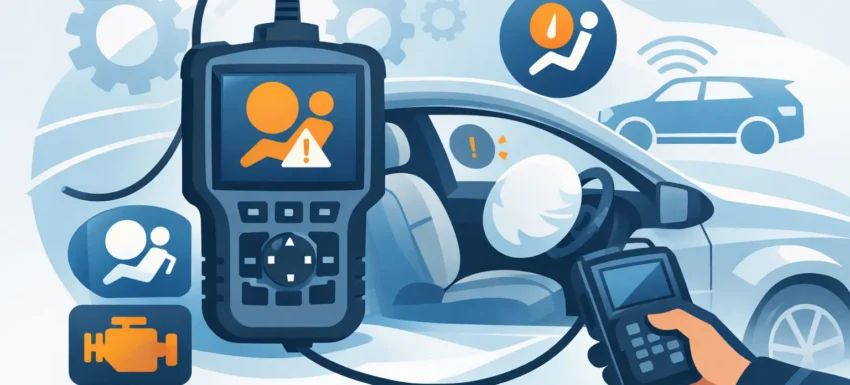
That airbag light is one of the few warning lamps you should never ignore. If you are asking what scanner reads airbag codes, the short answer is this: not every OBD2 scanner will do it. You need a tool with SRS or airbag system coverage, and in many cases you need one with the right software depth for your vehicle make, model and year.
This is where buyers often get caught out. A basic code reader might happily pull engine fault codes and clear an emissions light, but it can be completely blind to the airbag control unit. That does not mean the tool is faulty. It means it was never designed to communicate with that part of the vehicle.
What scanner reads airbag codes on modern vehicles?
A scanner that reads airbag codes is usually described as having SRS diagnostics. SRS stands for Supplemental Restraint System, which includes airbags, seatbelt pretensioners, crash sensors, occupancy sensors and the airbag module itself. If the scanner specification does not clearly mention SRS, airbag, restraint system or body module coverage, assume it will not read those faults.
On many newer vehicles, especially those with multiple modules and brand-specific communication protocols, you need more than generic OBD2 access. Generic OBD2 mainly covers emissions-related engine functions. Airbag diagnostics usually sit outside that basic standard. That is why workshop-grade scan tools, brand-specific units and advanced multi-system scanners are the tools that matter here.
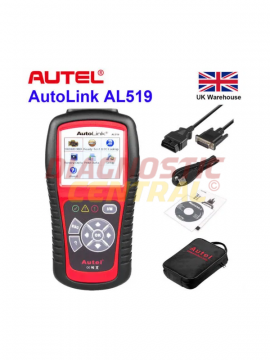
For a garage, mobile technician or serious DIY owner, the right choice is normally an all-systems diagnostic scanner. These tools can access engine, ABS, SRS, transmission, service functions and body electronics from one unit. That is the difference between guessing and seeing the actual fault stored in the airbag module.
Why a cheap code reader usually will not read airbag codes
There is a persistent misunderstanding in the market that any plug-in scanner can read every warning light. It cannot. A low-cost reader often gives you only powertrain fault codes. That is enough for a misfire or oxygen sensor issue, but not for an SRS warning.
Airbag systems are manufacturer-dependent, safety-critical and often tightly controlled in software. One vehicle may store a fault for driver seat resistance too high, another for crash sensor communication failure, and another for low voltage history in the restraint module. A basic reader may not even see that the module exists.
This matters because the airbag light can be triggered by more than a failed airbag. You might be dealing with a seat connector fault, damaged clock spring, battery voltage drop, water ingress, accident history or a failed control unit. Without a scanner that talks properly to the SRS module, you are working blind.
What to look for in a scanner that reads airbag codes
The first thing to check is stated system coverage. If the product only says OBD2, EOBD or engine diagnostics, that is not enough. You want clear confirmation of SRS or airbag diagnostics.
The second point is vehicle compatibility. A scanner may read airbag codes on one make but have limited SRS access on another. European, Asian and premium brands can vary a lot. Some tools are stronger on VAG, BMW or Mercedes systems, while others offer broader but shallower multi-make coverage.
The third point is functions. Reading codes is the starting point, but it is not the only job. A better scanner will also show live data where supported, display fault descriptions, erase codes after repair and sometimes carry out special functions such as module resets, steering angle calibration or service operations linked to related systems.
Screen quality, update support and build quality also matter more than people expect. In a workshop, speed counts. If the scanner takes too long to boot, has poor menu logic or weak software support, it slows the whole diagnostic process.
What scanner reads airbag codes best for DIY users?
For DIY users, the best scanner is usually not the cheapest one. It is the one that gives proper all-system access without making operation complicated. If you mainly want to diagnose your own car, a mid-range all-systems scanner with clear SRS coverage is often the sensible choice.
The key is to buy for the job, not the headline price. If your aim is to identify why the airbag light is on, a basic reader that only covers engine faults is false economy. Spend slightly more on a tool that reaches the restraint system and you save time, repeat purchases and unnecessary parts swapping.
There is one caveat. If you own a specific make and do most of your work on that brand alone, a make-focused diagnostic tool can sometimes offer deeper access than a generalist scanner. That can be a better fit than a broad multi-make unit, especially on vehicles with known SRS quirks.
What professionals should expect from an airbag-capable scanner
For trade use, airbag code reading needs to be fast, repeatable and reliable. A professional scanner should identify the vehicle correctly, access the SRS module without communication delays and present fault information in a way that helps decision-making. Generic code numbers with no context are not enough when the vehicle is booked in and ramp time costs money.
A workshop-level tool should also cope with wider diagnostic reality. An airbag light may not be a standalone problem. Low system voltage, poor earths, CAN communication faults or crash event data can sit behind it. A scanner that covers only one module is less useful than one that lets you compare faults across SRS, ABS, steering and body control systems.
This is also where reliability matters. Marketplace tools can look the part and still fall short on software quality, updates or actual module access. Professionals need hardware that earns its place in the toolbox, not something that works once and then leaves them second-guessing the result.
Can a scanner clear airbag codes too?
Yes, but only if the fault has been repaired and the scanner supports SRS code clearing. Reading and clearing are usually paired functions, though not always equally strong across every make.
It is worth being precise here. Clearing the code does not fix the problem. If the underlying fault remains, the airbag light will usually come straight back or return after the next ignition cycle. On some vehicles, stored crash data or hard faults in the module may need additional work beyond a normal code clear.
That is why a proper diagnostic approach matters. Read the codes, check the fault status, inspect the wiring or component involved, repair it properly and then clear and retest. If the scanner provides live data or module identification, use it. That extra information often saves time.
Common airbag faults a scanner can help pinpoint
An SRS-capable scanner can save a lot of guesswork because airbag faults often present the same dashboard light but come from very different causes. Common examples include seat occupancy sensor issues, high resistance in seatbelt pretensioner circuits, clock spring faults in the steering column, side airbag connector problems under the seats, battery voltage events and communication faults between modules.
That does not mean the scanner replaces electrical testing. It points you in the right direction. If the code says driver squib resistance high, you still need to inspect the related circuit and component properly. The scanner gets you to the right system fast. That alone is a major advantage.
Choosing the right tool without overbuying
Not everyone needs a top-end platform. If you run a general repair workshop, broad all-system coverage makes sense. If you are a mobile technician, speed, portability and strong multi-make support matter more. If you are a competent home mechanic, ease of use and confirmed compatibility with your own vehicle may be the deciding factor.
The right buying question is not simply what scanner reads airbag codes. It is what scanner reads airbag codes on the vehicles you actually work on, with the functions you really need. That is a more useful way to judge value.
Diagnostic Central generally sees the same pattern again and again: buyers who choose on capability first get results faster than buyers who choose on price first. With SRS diagnostics, that matters because these are safety systems, not convenience electronics.
If the airbag light is on, use a scanner built for the job, not a reader that only covers the basics. The right tool will not just show you a code – it gives you a clear starting point for a proper repair.