A vehicle can crank slowly, display several unrelated warning lights or refuse to start after standing overnight, yet still show more than 12 volts on a basic multimeter. That is why a proper 12v battery tester review needs to look beyond voltage. For workshop use, the useful question is whether the tester can assess the battery’s ability to deliver current, identify a charging fault and produce a result you can act on.
Quick answer
- A conductance tester is the best all-round choice for modern 12V vehicle batteries because it tests condition without applying a heavy load.
- Match the tester to the battery technologies you see: flooded, EFB, AGM and, where required, gel or lithium.
- Check both the battery rating range and the rating standards supported, such as EN, CCA, SAE, DIN, IEC and JIS.
- Charging and cranking tests make a tester far more useful than a battery-only checker, particularly for intermittent no-start faults.
What separates a useful tester from a voltage checker?
Voltage is a snapshot of electrical potential. A rested, healthy lead-acid battery should generally read around 12.6V, but a battery with reduced capacity or damaged plates can still display a respectable voltage and collapse as soon as the starter motor demands current. Equally, a recently charged battery can show an artificially high surface charge.
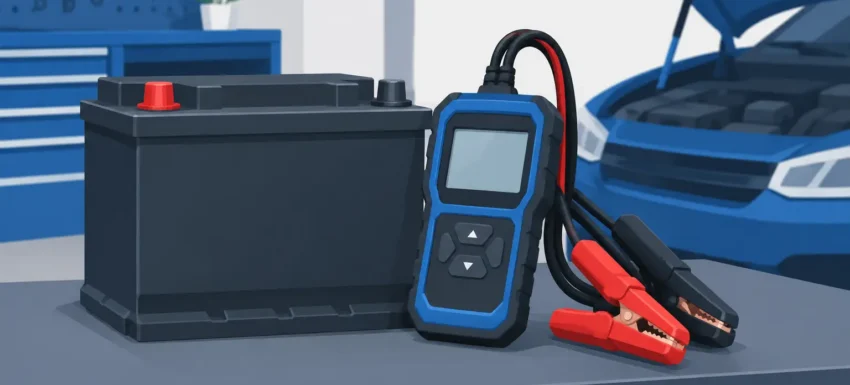
A battery tester uses conductance or impedance measurement to estimate the battery’s internal condition. It then compares the result with the battery’s stated cold cranking rating. The display will normally show voltage, measured starting capacity, internal resistance and a clear verdict such as good, recharge and retest, or replace.
That makes it a faster diagnostic tool, not a magic decision-maker. A poor result may be caused by a discharged battery, loose terminals, corrosion or an incorrect battery setting entered into the tester. It is sensible to inspect the battery and connections first, then charge and retest where the result calls for it.
12v battery tester review: the features that matter
Battery technology coverage
This is the first compatibility check. Conventional flooded batteries remain common, but stop-start vehicles increasingly use EFB or AGM batteries. An EFB setting is not a substitute for an AGM setting, and selecting the wrong type can produce an unreliable assessment. If you work on prestige vehicles, newer vans or vehicles with high electrical loads, AGM support should be high on the list.
Lithium 12V starter batteries are less common on everyday UK cars, but they do exist in specialist applications. Do not assume a lead-acid tester can evaluate them. Check the tester specification and the exact battery chemistry before connecting it.
Rating standards and test range
The label on a battery may show 680A EN, 760A CCA or another standard. A capable tester lets you choose the same standard and input the labelled value. This matters because 680A EN is not directly interchangeable with 680A CCA.
For a mixed car and light commercial workshop, choose a range that covers the smallest batteries you see as well as larger diesel, van and leisure batteries. Bigger numbers are not automatically better. A tester with a very wide advertised range is only useful if it supports the battery types and rating standards your customers actually use.
In-vehicle, cranking and charging tests
An in-vehicle test saves time because the battery can usually remain connected. However, the tester needs clean, secure contact at the battery posts. Testing through corroded clamps, painted brackets or a poor remote jump point can distort the reading.
Cranking tests record the voltage drop while the engine starts. A substantial drop can point towards a weak battery, poor earth connection, high-resistance cable or starter-motor issue. Charging-system tests assess alternator output, typically at idle and sometimes under electrical load. They are valuable because fitting a replacement battery without finding an overcharging or undercharging fault simply starts the problem again.
A charging test is a screening tool rather than a complete alternator diagnosis. Smart charging systems may alter voltage according to temperature, battery state of charge and ECU command. On some vehicles, a scan tool with live data is needed to see the commanded charge state and battery-management information.
Readability and workshop handling
A bright, plain-language display makes a difference on a busy ramp or at the roadside. Look for a tester that gives a stored result or printable report if you need to document health checks for customers. Report capability is particularly useful for service reception: it provides evidence for a battery recommendation rather than relying on a verbal judgement.
Cable quality matters too. Clamps should grip the lead posts firmly, and insulation should tolerate regular use. A compact handheld tester suits mobile technicians, while a larger model with a built-in printer may suit a fixed workshop reception area. Neither is inherently superior; choose around the job flow.
Which type of 12V tester suits your work?
For competent DIY use, a straightforward conductance tester that covers flooded, EFB and AGM batteries is normally the sensible starting point. It should support the rating printed on the battery and offer a simple pass, recharge or replace result. Avoid making a purchase solely because it includes numerous unfamiliar standards you will never use.
Independent garages benefit from a tester with cranking and charging analysis, report storage and a broad rating range. This reduces repeat work around starting complaints and gives technicians a quick first check before pursuing parasitic drain, starter or alternator faults.
Mobile technicians and recovery-focused users should prioritise speed, protected clamps and a display that remains legible outdoors. A tester that works from the battery being assessed is convenient, but it must still have enough voltage to power up. On a completely flat battery, charging or jump support may be needed before any electronic tester can deliver a meaningful result.
For lorries, agricultural equipment and fleets, do not buy a 12V-only unit by accident. Many systems use 24V arrangements, often with two 12V batteries in series. Each battery should usually be tested individually as well as checking the complete system, using equipment designed for the relevant voltage and battery capacity.
Common mistakes that lead to the wrong verdict
The most frequent error is entering the wrong battery rating. Read the actual label rather than guessing from engine size or assuming every battery on a model is identical. A replacement battery may have a different capacity and cold-cranking rating from the factory-fit unit.
The next is testing immediately after charging or a long drive. A surface charge can affect voltage readings. Many conductance testers compensate better than a simple voltmeter, but following the on-screen instructions remains the best approach. If a result is borderline, charge the battery fully and repeat the test before condemning it.
Finally, do not confuse a failed battery test with proof that the battery caused the original complaint. A good battery can still go flat because of excessive key-off draw, a module that fails to sleep, a charging fault or short journeys that never replace the energy used to start the engine. Battery health is one part of a structured diagnosis.
When a tester needs support from other diagnostics
A tester identifies battery condition quickly, but it cannot measure every cause of a no-start or low-voltage warning. If the battery repeatedly discharges, use a multimeter or current clamp to measure quiescent drain after the vehicle has entered sleep mode. If battery warning messages remain after replacement, check fault codes and live data with a compatible diagnostic scanner.
On battery-managed vehicles, replacement may also require a battery registration or reset procedure where supported. This tells the energy-management system that a new battery has been fitted and, on some makes, records battery type and capacity. Check the exact vehicle, system and required function before choosing diagnostic equipment.
FAQs
Can a 12V battery tester test a battery while connected to the car?
Usually, yes. Most conductance testers are designed for in-vehicle testing. Ensure the clamps connect directly to clean battery terminals where possible and switch off unnecessary electrical loads unless the tester instructs otherwise.
Does a battery tester tell me whether the alternator is faulty?
A model with charging-system testing can flag low or high charging voltage, but it cannot confirm every alternator, wiring, belt or ECU-control fault. Use the result as the starting point for further checks.
Is AGM support necessary?
It is necessary if you test AGM batteries, which are widely fitted to stop-start cars and vehicles with high electrical demand. Testing an AGM battery in a standard flooded mode can lead to an incorrect assessment.
What does ‘recharge and retest’ mean?
It means the battery’s state of charge is too low for a reliable health verdict. Fully charge it using a suitable charger, allow it to stabilise as instructed, then test again. If it still fails, replacement is more likely to be justified.
Choose a tester that reflects the vehicles on your ramp, not the longest specification sheet. If you need help matching battery, vehicle and diagnostic functions, contact Diagnostic Central with the registration or VIN and the function you require. A clear test result is useful, but the repair decision should always follow the evidence.