A vehicle arrives with an intermittent warning light, no obvious drivability complaint and a customer who needs it back the same day. This is where AI diagnostics can look attractive. The promise is faster pattern recognition, clearer fault suggestions and less time lost searching through live data. Used properly, it can support a technician’s decision-making. Used blindly, it can send a repair in the wrong direction.
Quick answer
- AI diagnostics can help prioritise likely causes from fault codes, live data and known repair patterns.
- It does not replace a proper scan, wiring checks, component testing or technician judgement.
- Results depend on the tool’s vehicle coverage, the quality of its data and whether the exact system is supported.
- A professional diagnostic process still starts with the complaint, verified faults and basic checks.
What AI diagnostics means in a real workshop
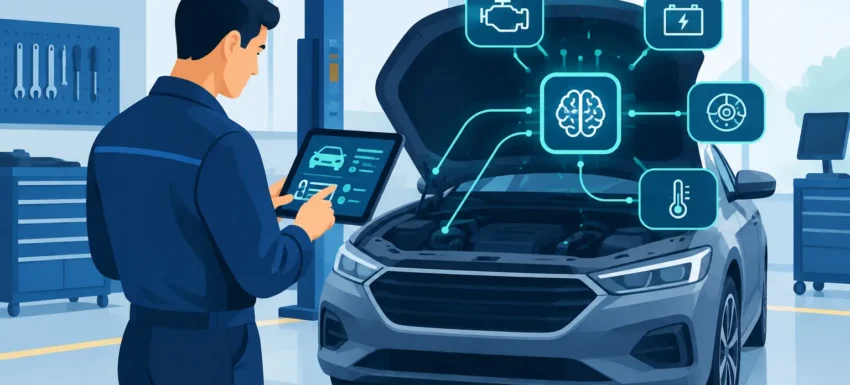
In automotive use, AI diagnostics usually refers to software that analyses vehicle information and suggests a likely route to a repair. That information may include diagnostic trouble codes, freeze-frame data, live readings, vehicle details, service information and previous cases from a manufacturer or repair database.
The useful part is not that the software somehow knows the fault without testing. It is that it can compare a set of symptoms with a large number of known patterns far faster than a person can search manually. For example, a system may identify that a particular combination of communication codes, low-voltage events and intermittent starting concerns is commonly linked to a battery, earth connection or power supply issue rather than three failed control units.
That can save valuable workshop time. It can also help a competent DIY user understand why clearing a code is not a repair. But the suggestion remains a starting point. A code for a turbocharger control fault may be caused by wiring, vacuum supply, actuator movement, boost leaks, sensor plausibility or the turbocharger itself. No software can accurately bypass the tests needed to separate those possibilities.
Where AI-assisted fault finding earns its place
The strongest use case is not a simple engine management light with one clear code. A capable OBD2 scanner can often deal with that first step. AI-assisted systems become more useful when the vehicle has multiple modules, inconsistent symptoms or a fault that needs context.
Sorting noise from useful evidence
Modern vehicles can store a long list of historic and current codes after a weak battery, jump start or poor connection. Reading every code as a separate failure is a common mistake. Pattern-based assistance can help identify the codes that are likely primary and those that are secondary consequences.
This is particularly useful on vehicles with CAN network faults. A module that loses its power or earth can generate warnings across the dash, affect several convenience functions and leave communication codes in other controllers. An intelligent diagnostic workflow may point the technician towards supply checks before expensive modules are condemned.
Making live data more practical
Live data is valuable, but it can be overwhelming. An engine ECU may offer hundreds of parameters, many with manufacturer-specific names and scaling. Diagnostic software can help flag readings that appear implausible for the operating conditions, compare related signals or recommend a test sequence.
Take a diesel DPF concern. Instead of focusing only on a warning message, the technician may need soot loading, differential pressure, exhaust temperature sensor values, calculated ash content, regeneration history and the conditions preventing regeneration. AI-led prompts can make that route clearer, but the readings still need checking against the vehicle’s actual condition. A blocked pressure pipe, failed sensor or unsuitable driving pattern will each require a different remedy.
Supporting faster research
Even experienced mechanics cannot carry every common fault pattern for every make, model, engine and year in their head. Case-based guidance can speed up research, particularly on newer vehicles with complex driver assistance, hybrid or body control systems.
It is most effective when the scan tool has correctly identified the vehicle and accessed the right control unit. Always check the exact registration, VIN, engine variant and installed equipment before relying on repair guidance. A function available on one trim level or production year may not be fitted to another.
The limits that matter before you trust a recommendation
AI is only as good as the evidence it receives. If the vehicle identification is wrong, the code descriptions are generic, or the scan tool has limited module coverage, the recommendation may be incomplete from the start.
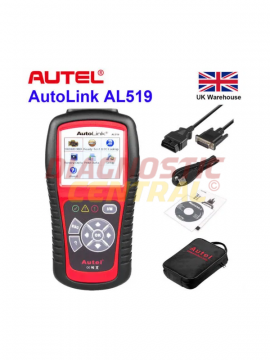
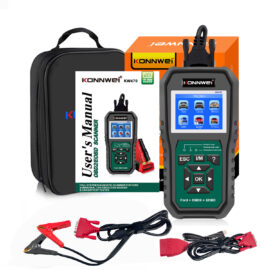
A basic code reader can be ideal for reading and clearing generic engine codes, checking readiness monitors and viewing a limited set of live data. It may not access manufacturer-specific modules, carry out active tests, code replacement parts or support service functions. Those limitations do not make it a poor tool. They simply define the work it is suited to.
For regular workshop use, a multi-system diagnostic tablet with broader vehicle coverage, live data graphing, actuator tests and guided functions is often the better foundation. On specialist jobs, brand-level software or a dedicated module may still be necessary. AI assistance cannot create access to a control unit, security function or coding routine that the hardware and subscription do not support.
There is also a commercial risk in accepting an automated diagnosis too quickly. A suggested component replacement may sound convincing, particularly when it matches a stored code. Before fitting parts, confirm power, earth, wiring integrity, reference voltages, signal behaviour and mechanical condition as appropriate. This protects the customer, reduces returns and maintains workshop credibility.
A reliable process for using AI diagnostics
Treat AI as a second technician looking over the evidence, not as the person signing off the job. The best results come from a disciplined sequence.
Start by recording the customer complaint accurately. Note when the fault occurs, whether it is temperature-related, if it follows a repair, and whether warning lights or messages were present. Carry out a visual inspection for damaged wiring, fluid ingress, loose connectors, poor battery terminals and obvious mechanical faults.
Next, identify the vehicle correctly and perform a full system scan where supported. Save the original fault report before clearing anything. Look at code status, freeze-frame information and the relationship between modules. Check battery condition and charging voltage early, especially where multiple electrical faults are present.
Then use the AI or guided information to form testable hypotheses. If it suggests an intake leak, verify it through suitable inspection, smoke testing or measured data. If it points towards a wheel speed sensor, compare all wheel speeds, inspect the wiring route and check for bearing or reluctor-ring issues. A prompt is useful only when it leads to a measurable check.
Finally, confirm the repair. Clear codes only after the fault has been addressed, complete the relevant drive cycle or functional test, and rescan the vehicle. Some systems need calibrations, adaptations or relearns after repair. Check whether these functions are supported by the chosen diagnostic equipment before starting work.
Choosing equipment for AI-supported diagnostics
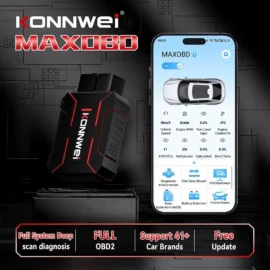
The right purchase depends on the work you actually undertake. For a capable home user, an OBD2 scanner with clear code definitions, live data and vehicle-specific coverage where stated may be enough for routine fault investigation. It is a practical way to identify why an engine management light has appeared, but it should not be assumed to diagnose every system on every vehicle.
Independent garages and mobile technicians will usually benefit from a more advanced diagnostic platform that can scan multiple systems, display and graph live data, run active tests and carry out common service functions. These features provide the evidence that makes AI-style guidance genuinely useful.
Commercial vehicle work brings further considerations. Lorry and trailer systems may require the correct heavy-duty diagnostic interface and adapter cables, along with coverage for the relevant makes, protocols and brake or trailer systems. Check these details before purchase rather than assuming a passenger-car tool will cover commercial work.
Diagnostic Central’s experienced mechanics recommend choosing the tool around the vehicles, modules and functions you need today, while allowing sensible room for future work. Coverage claims should always be checked against the exact vehicle and task, particularly for coding, immobiliser, ADAS, battery registration and advanced service procedures.
FAQs about AI diagnostics
Can AI diagnostics tell me exactly which part has failed?
Not reliably on its own. It can identify likely causes and guide the next checks, but a fault code or prediction is not proof that a specific part is defective. Electrical and mechanical testing is still required.
Will an AI diagnostic tool work on every car?
No. Coverage varies by tool, vehicle manufacturer, model year, engine, fitted modules and subscription level. Check the exact vehicle and required functions before buying.
Is AI diagnostics useful for DIY users?
Yes, where expectations are realistic. It can make code information and likely causes easier to understand, but safety-critical repairs, high-voltage systems and security functions should be handled by suitably trained people with the correct equipment.
Does clearing fault codes fix the problem?
Usually not. Clearing codes removes the stored record and may switch off a warning temporarily, but the code will return if the underlying fault remains. Save the scan report first and use it to guide testing.
The best diagnostic result is not the fastest code read. It is a verified repair with evidence behind it. If you are choosing equipment, contact Diagnostic Central with the registration or VIN, the systems you need to access and the functions you require, and the team can help narrow down a suitable option.