
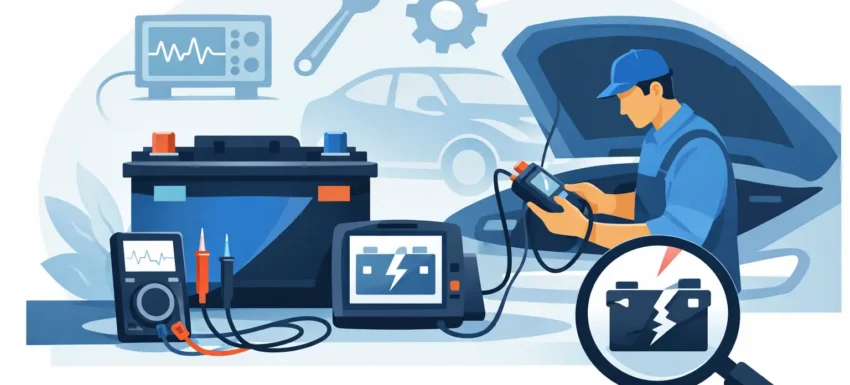
A battery can show 12.6V at the posts, illuminate the dash and still be the reason a vehicle will not start. That is why a proper workshop battery testing guide starts with more than a voltmeter reading. Modern vehicles rely on stable voltage for engine management, stop-start systems, electric steering, security modules and diagnostics. Test the battery properly before condemning a starter motor, alternator or control unit.
For garages and mobile technicians, the aim is simple: establish the battery’s state of charge, its ability to deliver current, and whether the vehicle charging system is supporting it. That process prevents unnecessary parts replacement and gives the customer a clear, defensible result.
Start with the right battery details
Before connecting a tester, identify the battery technology and its rated capacity. A conventional flooded lead-acid battery is not assessed in exactly the same way as an AGM or EFB stop-start battery. Selecting the wrong type in a conductance tester can produce an unreliable health result and may lead to a battery being replaced when charging or further investigation would have solved the fault.
Check the label for the battery type, amp-hour rating and stated cranking standard. In the UK, CCA is commonly quoted using EN, SAE, IEC or DIN. Enter the figure and standard printed on the label, not a guessed equivalent. A 700A EN battery is not automatically 700A SAE.
Also inspect the physical installation. Loose terminals, green or white corrosion, damaged earth straps, a cracked case, swelling, electrolyte leakage and a battery that has moved in its tray all need attention before testing. A clean connection is essential. Testing through corroded terminals can make a serviceable battery appear weak.
Check state of charge before judging battery health
Voltage gives a useful first indication, but it is not a capacity test. For a 12V lead-acid battery that has been allowed to rest with the vehicle switched off, around 12.6V to 12.8V normally indicates a high state of charge. Around 12.4V suggests partial charge, while 12.2V or lower is significantly discharged. These figures are guides, not a final verdict.
A recently charged battery may hold a surface charge and read artificially high. Switch the headlamps on for a short period, then switch them off and allow the voltage to settle before testing. Conversely, a battery tested immediately after a difficult start may show a low reading simply because it has not recovered.
If the state of charge is low, charge the battery with a suitable smart charger before performing a final health test. Conductance testers can often identify a weak unit from a discharged state, but a low charge level can limit confidence in the result. Record it as “charge and retest” where appropriate rather than selling a replacement on incomplete evidence.
Use a battery tester, not voltage alone
A professional battery tester measures internal conductance or resistance and estimates available cranking performance against the battery’s rated CCA. This is far more useful than open-circuit voltage because it assesses whether the battery can supply high current when the starter demands it.
Connect the tester directly to the battery posts wherever possible. If the battery is located in the boot or under a seat, use the actual posts rather than remote jump points when access is safe and practical. Select the correct battery type and rating, then allow the tester to complete its assessment.
A typical result will identify the state of charge and state of health, with an available CCA figure. A battery can be fully charged but have poor health because sulphation, plate damage or age has reduced its current delivery. Equally, a healthy but discharged battery should be recharged and retested, then investigated for the reason it went flat.
Traditional carbon-pile load testing still has a place, particularly on older workshop stock and heavy-duty applications, but it demands care and experience. The battery must be suitably charged, and the load must be applied correctly for the battery rating. Modern electronic testers are quicker, safer and better suited to daily vehicle intake checks, but they do not remove the need to inspect cables and confirm the starting circuit under load.
Test the battery while cranking
When a vehicle has a slow-crank or intermittent no-start complaint, test voltage drop during cranking. Disable starting only where necessary and follow the vehicle manufacturer’s procedure, especially on modern diesel and hybrid systems. Observe battery voltage while the engine is cranked.
As a general workshop guide, a 12V battery should usually remain above roughly 9.6V during a normal cranking test at moderate temperatures. A lower figure points towards a weak battery, excessive starter draw or high resistance in the cable connections. Cold weather increases demand and can lower the reading, so use the result alongside the conductance test and the vehicle’s symptoms.
Do not stop at the battery terminals. Measure voltage drop from the battery positive post to the starter feed, then from the starter casing or engine block back to the battery negative post. Excessive resistance in a positive cable, engine earth strap or terminal can imitate battery failure. If the battery tests well but the voltage at the starter collapses, the fault is in the circuit, not the battery.
Starter current testing adds another layer of certainty. High current with slow cranking can indicate a tight or failing starter motor or mechanical engine issue. Low current and slow cranking may suggest a poor feed, bad earth or solenoid problem. The numbers depend on the vehicle, so compare with known-good data where available rather than relying on a single universal figure.
Verify charging voltage and charging behaviour
Once the engine is running, check whether the charging system is replenishing the battery. On many conventional systems, charging voltage at the battery will sit broadly between 13.8V and 14.7V, depending on temperature and electrical load. Test at idle and with suitable loads applied, such as headlamps, heated rear window and blower motor.
Modern smart charging systems need a more considered approach. A vehicle with battery monitoring may deliberately allow voltage to vary, sometimes dropping near battery voltage during light load and increasing during regeneration or after a start. A single reading at idle is not enough to condemn an alternator. Scan the vehicle for battery-management and charging faults, check the battery sensor connection, and review live data where the diagnostic system supports it.
After battery replacement on vehicles with a battery energy management system, the new battery may require registration or coding. This tells the vehicle the capacity, technology and age of the installed unit. Skipping this step can shorten battery life or cause stop-start performance issues, even when the replacement battery itself is correct.
Investigate repeated flat batteries methodically
A battery that repeatedly goes flat is a symptom, not always the fault. First confirm it is being fully charged during normal use. Short journeys, especially in winter, can leave a stop-start battery permanently undercharged. Then assess whether the battery holds charge after being disconnected or isolated.
If the battery is healthy and charging is correct, carry out a parasitic draw test. Allow the vehicle to enter sleep mode before taking a reading. Opening a door, switching on the ignition or disturbing the key can wake modules and give a false high result. Use a clamp meter where possible to avoid interrupting the circuit and resetting modules.
A normal quiescent current varies by vehicle, fitted equipment and how long modules take to sleep. Many vehicles settle below 50mA, but do not use that figure blindly. A modern premium vehicle, tracker, dash camera or aftermarket audio system may need separate evaluation. The useful finding is an abnormal current that remains present after the vehicle should be asleep, then falls when a relevant fuse, module or accessory is isolated.
Record results the customer can understand
A battery test is more valuable when the findings are written down. Record the battery type and rated CCA, state of charge, test result, available CCA, cranking voltage, charging behaviour and any observed cable condition. A printed tester report gives the customer evidence and gives the workshop a baseline if the vehicle returns.
Be precise with recommendations. “Replace battery” is justified when the test confirms poor health, the battery is correctly charged and the starting system has been checked. “Recharge and retest” is the right outcome for a discharged battery with acceptable conductance. Where the battery passes but starting remains poor, move directly to voltage-drop and starter testing rather than fitting parts by instinct.
A dependable battery tester earns its place because it turns a common complaint into measured evidence. Test at intake, test before replacing expensive electrical components, and make charging-system checks part of the same job. The fastest repair is usually the one that begins with the right numbers.