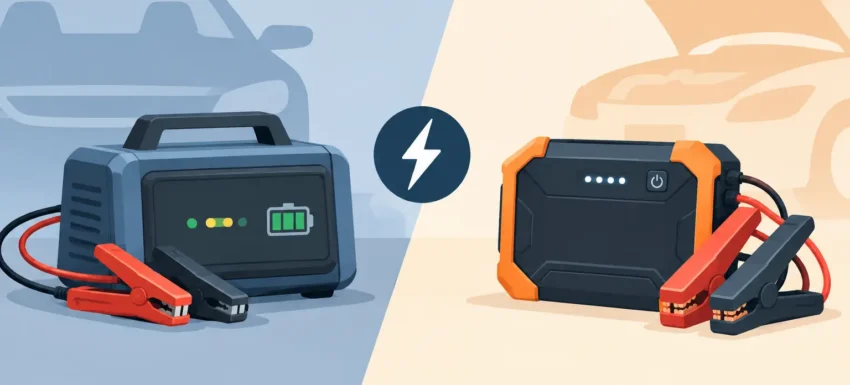
A flat battery at the workshop door, on a customer’s drive or in a supermarket car park needs the right response, not just the nearest tool. The battery charger versus jump starter question comes down to one key distinction: a charger restores battery state of charge over time, while a jump starter delivers a short, high-current boost to crank the engine. Both earn their place in a serious vehicle toolkit, but they solve different problems.
Choose the wrong one and you can lose time, mask a failing battery or place unnecessary strain on electrical components. Choose correctly and you can get a vehicle moving, assess its real condition and avoid repeat call-backs.
Battery charger versus jump starter: the core difference
A battery charger connects to the battery and supplies controlled current for an extended period. Its purpose is to replenish the energy removed through starting, short journeys, parasitic drain or periods of storage. Modern smart chargers monitor voltage and, depending on the model, may adjust the charging cycle, maintain a battery and support AGM, EFB, gel or conventional lead-acid types.
A jump starter is a portable power pack designed to provide the high current needed for a few seconds of engine cranking. It is the fast answer when a vehicle must start now. Most compact lithium jump packs can start many petrol and diesel passenger vehicles, while heavier-duty units are better suited to larger engines, vans and commercial applications.
The essential point is simple: starting an engine is not the same as charging a battery. A vehicle that starts with a jump pack may still have a battery that is severely discharged, sulphated, internally damaged or unable to hold charge.
When a battery charger is the right tool
Use a charger when time is available and the aim is to restore battery charge properly. This is the more controlled approach for a vehicle that has been standing, is used only for short trips or has been left with an interior light, accessory or module awake.
For garages, chargers are particularly useful during diagnostic work. Modern vehicles can draw considerable current with ignition on, doors open and scan tools communicating with multiple control modules. Low voltage can create misleading fault codes, interrupt programming procedures and cause modules to behave unpredictably. A suitable battery support unit or stabilised power supply is often a better choice than a basic charger for coding, software updates and extended diagnostic sessions.
A smart charger also gives you a clearer picture of battery recovery. If charging completes unusually quickly, the voltage drops shortly after disconnection, or the battery cannot crank the engine after a full charge, further testing is needed. That is where a proper battery tester becomes valuable. Voltage alone does not confirm usable capacity or cold-cranking performance.
Best charger applications
A charger is generally the better option for overnight recovery, seasonal vehicles, motorcycles, leisure batteries and workshop maintenance. It is also the sensible choice after repeated short journeys, provided the underlying reason for discharge has been addressed.
If a battery has been deeply discharged, allow it to charge fully before judging it. Starting the vehicle immediately after a brief charge can produce a false impression that the fault has been fixed. Once the surface charge settles, the same weak battery may fail again.
When a jump starter is the right tool
A jump starter is built for speed and mobility. Mobile mechanics, recovery operators and technicians working away from a mains supply need one because waiting hours for a battery to charge is rarely practical.
It is ideal where the battery is simply too low to crank but the vehicle needs moving into the workshop, loading onto a transporter or started for immediate testing. It is also useful when a known-good vehicle has been left unused briefly and there is no reason to suspect a permanent battery fault.
The better units include reverse-polarity protection, short-circuit protection and intelligent clamps. These features reduce risk, but they do not replace correct connection procedures. Connect positive to positive first, connect the negative clamp as instructed by the jump starter manufacturer, keep clamps clear of moving parts and remove the unit once the engine is stable.
Do not treat a jump pack as a cure for every no-start. If an engine turns slowly even with a suitably rated jump starter, investigate battery connections, earth straps, starter motor current draw and the charging system. If it does not crank at all, scan for immobiliser, starter relay, brake pedal switch, clutch switch or network-related issues before assuming the battery is at fault.
Starting power is not battery health
This is the mistake that costs workshops time. A vehicle starts after being jump-started, so the battery is declared fine. Then it returns two days later on a recovery lorry.
A jump starter can overcome a weak battery temporarily because it adds external cranking current. It does not prove the battery can store energy, accept a charge or support the electrical load once the engine is switched off. Equally, a battery may show 12.6V at rest and still fail a conductance or load test due to poor internal condition.
After a successful jump-start, check charging voltage and battery condition. On many conventional systems, alternator output will commonly sit around the mid-13V to mid-14V range, although smart charging systems vary output according to demand, battery temperature and operating strategy. A reading outside an expected range is a prompt for further diagnosis, not an automatic alternator verdict.
Assess the battery with the correct settings for its type and rated capacity. Then check for excessive parasitic draw if the battery is repeatedly flat. A charger will replenish the battery, and a jump starter will get the engine running, but neither identifies a glovebox lamp, aftermarket accessory, faulty module or charging fault that is draining it.
Choosing equipment for the job
For technically minded motorists, a compact smart charger and a quality lithium jump starter make a practical pairing. The jump pack gets you out of trouble at the roadside; the charger lets you recover the battery properly at home and reduces the chance of another non-start.
For a professional workshop, specification matters more than headline claims. Consider battery chemistry support, maximum charging current, maintenance mode, cable length, clamp quality and whether the unit provides a stable supply mode for diagnostics and programming. A low-cost charger that cannot maintain voltage under workshop load is not the right tool for modern vehicle electronics.
With jump starters, look at peak and starting current claims in context, the engine sizes you actually see, clamp construction, safety protection, battery capacity and recharge method. A small pack may be excellent for a 1.0-litre petrol hatchback but unsuitable for a cold 3.0-litre diesel or a high-compression commercial vehicle. For fleet and trade use, choose with headroom rather than buying to the absolute minimum rating.
Battery location also affects the decision. Some vehicles have remote jump terminals under the bonnet while the battery is in the boot, under a seat or beneath trim. Use the manufacturer-approved jump points where provided. On vehicles with battery monitoring sensors, incorrect connection can affect monitoring accuracy or create avoidable faults.
Safety and modern vehicle considerations
Never charge a visibly damaged, leaking, swollen or frozen battery. Ventilate the area, keep sparks and flames away and follow the battery and charger instructions. Lead-acid batteries can release explosive gas during charging, while damaged lithium starter packs require a different level of caution.
Before charging, identify the battery technology fitted. Stop-start vehicles commonly use AGM or EFB batteries, and fitting the wrong charging programme can shorten service life. When replacing a battery on vehicles that require battery registration or adaptation, complete the procedure with a compatible diagnostic tool. Failure to do so may affect charging strategy and battery longevity.
For Diagnostic Central customers, this is where a disciplined workflow pays for itself: confirm the battery condition, verify alternator behaviour, check for stored low-voltage faults and investigate parasitic draw where the history points that way. Guessing from one voltage reading is not diagnostics.
The practical answer for garages and drivers
If the vehicle needs to move immediately, use a correctly rated jump starter. If the battery needs restoring, use a smart charger. If the battery keeps going flat, neither tool is the final answer until you have tested the battery and charging system, then investigated the cause of the discharge.
Keep both tools ready, but use them with purpose. The quickest start is useful; the correct diagnosis is what keeps the vehicle from coming back.